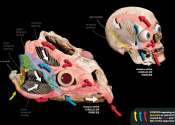
Studying the Noble King Mackerel
Scientists studying how early land vertebrates evolved from fishes long thought that the animals developed legs for moving around on land well before their feeding systems and dietary habits changed enough ...
Our family tree may have sprouted some long-lost branches going back nearly 2 million years. A famous paleontology family has found fossils that they think confirm their theory that there are two additional ...
It takes both teeth and jaws to make a pretty smile, but the evolutionary origins of these parts of our anatomy have only just been discovered, thanks to a particle accelerator and a long dead fish.
The common ancestor of all jawed vertebrates on Earth resembled a shark, according to a new analysis of the braincase of a 290-million-year-old fossil fish that has long puzzled paleontologists.
(PhysOrg.com) -- Scientists have identified a new species of gigantic theropod dinosaur, a close relative of T. rex, from fossil skull and jaw bones discovered in China.
(PhysOrg.com) -- Fossils of bizarre lizard-like, snail-eating marsupials have been discovered by UNSW palaeontologists in an ancient fossil field in the Riversleigh World Heritage area in Queensland. The fossils ...
(AP)—Mexican archaeologists said Friday they uncovered the largest number of skulls ever found in one offering at the most sacred temple of the Aztec empire dating back more than 500 years.
(Phys.org)—Using CAT scans and making 3-D virtual reconstructions of the jaws of the ancient fish Helicoprion, Idaho State University researchers have solved some of the mysteries surrounding large spiral ...
(PhysOrg.com) -- The remains of an extraordinary fossil unearthed in 67-million-year-old sediments from Gujarat, western India provide a rare glimpse at an unusual feeding behavior in ancient snakes.
With tiny 1-inch long jaws, a new species of plant-eater has come to light in rocks in southern Africa dating to the early dinosaur era, some 200 million years ago. This "punk-sized" herbivore is one of a ...
Research at the University of Liverpool, using computer models to reconstruct the jaw muscle of Tyrannosaurus rex, has suggested that the dinosaur had the most powerful bite of any living or extinct terres ...
Two new horned dinosaurs have been named based on fossils collected from Alberta, Canada. The new species, Unescopceratops koppelhusae and Gryphoceratops morrisoni, are from the Leptoceratopsidae family of hor ...
Recent research has brought to light the illegal practice of using mantraps to catch chimps in Uganda.
Going against the flow is always a challenge, but some waterfall-climbing fish have adapted to their extreme lifestyle by using the same set of muscles for both climbing and eating, according to research ...