Astronomers discover largest stellar black hole in Milky Way: Study
Astronomers identified the largest stellar black hole yet discovered in the Milky Way, with a mass 33 times that of the Sun, according to a study published on Tuesday.

Astronomers identified the largest stellar black hole yet discovered in the Milky Way, with a mass 33 times that of the Sun, according to a study published on Tuesday.
Astronomy
Apr 20, 2024
2
109

It's an exciting time for the fields of astronomy, astrophysics, and cosmology. Thanks to cutting-edge observatories, instruments, and new techniques, scientists are getting closer to experimentally verifying theories that ...
Astronomy
Apr 15, 2024
0
37

Researchers from the University of Portsmouth's Institute of Cosmology and Gravitation (ICG) have helped to detect a remarkable gravitational-wave signal, which could hold the key to solving a cosmic mystery.
Astronomy
Apr 8, 2024
0
101

Optical sensors serve as the backbone of numerous scientific and technological endeavors, from detecting gravitational waves to imaging biological tissues for medical diagnostics. These sensors use light to detect changes ...
Optics & Photonics
Apr 6, 2024
0
146

The detection of gravitational waves stands as one of the most significant achievements in modern physics. In 2017, gravitational waves from the merger of a binary neutron star were detected for the first time which uncovered ...
General Physics
Apr 5, 2024
0
570
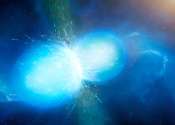
Could it be that human existence depends on gravitational waves? Some key elements in our biological makeup may come from astrophysical events that occur because gravitational waves exist, a research team headed by John R. ...
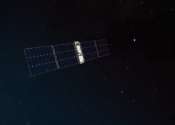
NASA's BurstCube, a shoebox-sized satellite designed to study the universe's most powerful explosions, is on its way to the International Space Station.
Astronomy
Mar 22, 2024
0
25

A team of physicists has developed a method to detect gravity waves with such low frequencies that they could unlock the secrets behind the early phases of mergers between supermassive black holes, the heaviest objects in ...
General Physics
Mar 8, 2024
1
804

Neutron star mergers are a treasure trove for new physics signals, with implications for determining the true nature of dark matter, according to research from Washington University in St. Louis.
Astronomy
Mar 6, 2024
0
160

Gravitationally speaking, the universe is a noisy place. A hodgepodge of gravitational waves from unknown sources streams unpredictably around space, including possibly from the early universe.
In physics, a gravitational wave is a fluctuation in the curvature of spacetime which propagates as a wave, traveling outward from the source. Predicted by Einstein's theory of general relativity, the waves transport energy known as gravitational radiation. Sources of gravitational waves include binary star systems composed of white dwarfs, neutron stars, or black holes.
Although gravitational radiation has not yet been directly detected, it has been indirectly shown to exist. This was the basis for the 1993 Nobel Prize in Physics, awarded for measurements of the Hulse-Taylor binary system. Various gravitational wave detectors exist.
This text uses material from Wikipedia, licensed under CC BY-SA
