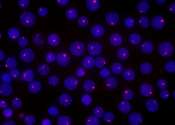
Scientists develop mouse model that can advance research on iPS cells to the next step
VIB scientists associated to the UGent have developed a mouse model that can advance the research on iPS cells to the next step.
Researchers in Japan have moved one step closer to clinical trials using adult stem cells in a therapy they hope will prove a cure for common sight problems, an official said Thursday.
Scientists at the University of Southampton have created a new method to generate bone cells which could lead to revolutionary bone repair therapies for people with bone fractures or those who need hip replacement surgery ...
A single embryonic stem cell can develop into more than 200 specialized cell types that make up our body. This maturation process is called differentiation and is tightly regulated. If the regulation is lost, ...
A natural trigger that enables stem cells to become any cell-type in the body has been discovered by scientists.
(Phys.org)—A Simon Fraser University chemist is the lead author on a new paper that advances scientific understanding of the structure and function of glycoproteins, in particular the number and positioning of sugars on ...
A team of researchers from Scotland has used a novel 3D printing technique to arrange human embryonic stem cells (hESCs) for the very first time.
Whitehead Institute researchers have determined that DNA transcription, the process that produces messenger RNA (mRNA) templates used in protein production, also runs in the opposite direction along the DNA to create corresponding ...
Many different tissues and organs form from pluripotent stem cells during embryonic development. To date it had been known that these processes are controlled by transcription factors for specific tissues. ...
Stem cell manufacturing for drug screening and treatments for diseases such as Huntington's and Parkinson's could be boosted by a new method of generating stem cells, a study suggests.
When an embryonic stem cell is in the first stage of its development it has the potential to grow into any type of cell in the body, a state scientists call undifferentiated.
Unlike less versatile muscle or nerve cells, embryonic stem cells are by definition equipped to assume any cellular role. Scientists call this flexibility "pluripotency," meaning that as an organism develops, ...
The discovery of the Higgs Boson, an invisible particle that explains the mystery of mass, leads a list of the top 10 scientific advances of 2012 released Thursday by the US journal Science.
(AP)—California has transformed into a major player in stem cell research, but the taxpayer-funded institute responsible has "significant deficiencies" in how research dollars are distributed, experts said Thursday.
Induced pluripotent stem (iPS) cells have the potential to form any cell type in the body, providing a powerful tool for drug discovery and regenerative medicine. Yet coaxing these cells to reliably take on a specific fate ...