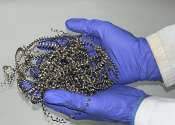
Kinks and curves at the nanoscale
One of the basic principles of nanotechnology is that when you make things extremely small—one nanometer is about five atoms wide, 100,000 times smaller than the diameter of a human hair—they are going ...
(Phys.org) —Just a few drops of liquid or a bit more is run past specialized sensors in microfluidic devices to detect chemicals of concern to doctors and security personnel. However, these devices are ...
One of the most promising new kinds of battery to power electric cars is called a lithium-air battery, which could store up to four times as much energy per pound as today's best lithium-ion batteries. But ...
(Phys.org) —Researchers at the University of California, Berkeley, have discovered that a nanocrystal moving through a nanotube due to an electric charge is able to pass through a portion of the nanotube ...
(Phys.org) —The macroscopic effects of certain nanoparticles on human health have long been clear to the naked eye. What scientists have lacked is the ability to see the detailed movements of individual ...
(Phys.org) —In a new study performed at the Center for Nanoscale Materials at the U.S. Department of Energy's (DOE) Argonne National Laboratory, researchers have for the first time seen the self-assembly ...
Salt plays a greater role in undermining chalk cliffs than previously thought, say scientists. Until recently, if a chalk cliff collapsed it was blamed on waves eroding its base, or the chalk weakening as ...
(Phys.org) —Scientists use scanning electron microscopes (SEMs) to study tiny structures in small organisms. SEMs can only work in a high vacuum, and exposure to such a vacuum normally causes living things ...
(Phys.org) —Jumping silicon atoms are the stars of an atomic scale ballet featured in a new Nature Communications study from the Department of Energy's Oak Ridge National Laboratory.
(Phys.org) —Space tethers hold intriguing potential for satellite manoeuvring, attitude control and even power generation. But about half of all orbital tether tests have either failed to deploy or snapped, ...
Imagine if you could drink a glass of water just by inserting a solid wire into it and sucking on it as though it were a soda straw. It turns out that if you were tiny enough, that method would work just fine—and wouldn't ...
A patent-pending technology to produce nanospheres developed by a research team at North Dakota State University, Fargo, could enable advances across multiple industries, including electronics, manufacturing, ...
(Phys.org) —Engineers at the University of California, San Diego are developing nanofoams that could be used to make better body armor; prevent traumatic brain injury and blast-related lung injuries in ...
Have you ever thrown into the fire - even if you shouldn't have - an empty packet of crisps? The outcome is striking: the plastic shrivels and bends into itself, until it turns into a small crumpled and blackened ...
A research team headed by Professor Gao Chao have developed ultra-light aerogel – it breaks the record of the world's lightest material with surprising flexibility and oil-absorption. This progress is published ...