Frontpage » Tag » coffee

News tagged with coffee

Fair trade coffee - good for cafes and growers

While fair trade coffee results in more money in the pockets of coffee growers in developing countries, it can also bring better returns for cafés here in New Zealand.

Other Sciences / Other

created May 04, 2012 | popularity not rated yet | comments 0

From food waste to bus fuel and biofertilizer

Banana peel, coffee grounds and other food waste will be transformed into green fuel for Oslo’s city buses starting next year. The Norwegian capital’s new biogas plant will also supply nutrient-rich ...

Technology / Energy & Green Tech

created Mar 19, 2012 | popularity 5 / 5 (1) | comments 0

An integrated pest management program for coffee berry borer in Colombia

The coffee berry borer, Hypothenemus hampei (Ferrari), is considered one of the most serious pests in coffee plantations worldwide. Infestations of this small beetle are difficult to combat; most of the in ...

Biology / Ecology

created Mar 14, 2012 | popularity not rated yet | comments 0

Gene found to have jumped from gut bacteria to beetle

(PhysOrg.com) -- Genes jumping between bacteria are rather common which in part explains their ability to rapidly develop immunity to antibacterial agents. What’s not so common are examples of genes jumping ...

Biology / Biotechnology

created Feb 28, 2012 | popularity 5 / 5 (7) | comments 3 | with audio podcast report

Carbonized coffee grounds remove foul smells

For coffee lovers, the first cup of the morning is one of life's best aromas. But did you know that the leftover grounds could eliminate one of the worst smells around – sewer gas?

Chemistry / Materials Science

created Feb 08, 2012 | popularity 5 / 5 (4) | comments 2 | with audio podcast

Air France fined 146,000 euros for 'poisoned' coffee

A French court on Friday ordered Air France to pay 146,000 euros (186,000 dollars) to compensate a passenger who said he was served poisoned coffee on a domestic flight in 2006.

Technology / Business

created Jan 13, 2012 | popularity not rated yet | comments 6

Why coffee drinking reduces the risk of Type 2 diabetes

Why do heavy coffee drinkers have a lower risk of developing Type 2 diabetes, a disease on the increase around the world that can lead to serious health problems? Scientists are offering a new solution to ...

Chemistry / Biochemistry

created Jan 11, 2012 | popularity 3.8 / 5 (6) | comments 9

How granular material becomes solid: Stress causes clogs in coffee and coal

It's easy to get in a jam. But it's much harder to explain exactly how or when it started.

Physics / General Physics

created Dec 14, 2011 | popularity 5 / 5 (4) | comments 4 | with audio podcast

Public Wi-Fi convenient, but risky

It seems you can surf the Internet and check your email from virtually anywhere these days - in coffee shops, hotel lobbies, airport terminals and airplane cabins.

Technology / Telecom

created Nov 10, 2011 | popularity not rated yet | comments 1

Rebuilding the head of an armoured dinosaur (w/ video)

(PhysOrg.com) -- A University of Alberta-led research team has taken a rare look inside the skull of a dinosaur and come away with unprecedented details on the brain and nasal passages of the 72 million year ...

Other Sciences / Archaeology & Fossils

created Sep 29, 2011 | popularity 5 / 5 (4) | comments 2 | with audio podcast

Coffee could offer key ingredient for new treatments for Parkinson's disease

Scientists from Heptares Therapeutics have used Diamond Light Source, the UK’s national synchrotron facility, to understand the structure of a protein involved in Parkinson’s disease and other neurological ...

Chemistry / Biochemistry

created Sep 05, 2011 | popularity 4 / 5 (2) | comments 0

Physicists undo the 'coffee ring effect' (w/ video)

A team of University of Pennsylvania physicists has shown how to disrupt the "coffee ring effect" — the ring-shaped stain of particles leftover after coffee drops evaporate — by changing the particle ...

Physics / General Physics

created Aug 17, 2011 | popularity 4.5 / 5 (13) | comments 1 | with audio podcast

Scientists explore the role of aeroecology in bat conservation and ecosystem health

Golf courses and coffee plantations are some of the unlikely bat habitats that could be considered in conservation plans, say scientists presenting research at the Ecological Society of America's (ESA) 96th Annual Meeting ...

Biology / Ecology

created Aug 11, 2011 | popularity not rated yet | comments 0

Pistachios make healthy decafs

If caffeine gets your blood pumping more than it should, here's a piece of good news: when roasted appropriately, pistachios can become a tasty and healthier substitute for coffee, with all the aromas and ...

Chemistry / Other

created Jun 23, 2011 | popularity 5 / 5 (1) | comments 1

UW-Madison scientists create low-acrylamide potato lines

(PhysOrg.com) -- What do Americans love more than French fries and potato chips? Not much-but perhaps we love them more than we ought to. Fat and calories aside, both foods contain high levels of a compound called acrylamide, ...

Biology / Biotechnology

created Jun 10, 2011 | popularity 5 / 5 (1) | comments 0

Coffee

Coffee is a brewed beverage prepared from roasted seeds, commonly called coffee beans, of the coffee plant. Due to its caffeine content, coffee can have a stimulating effect in humans. Today, coffee is one of the most popular beverages worldwide.

It is supposed that the Ethiopians, the ancestors of today's Galla tribe, were the first to have discovered and recognized the energizing effect of the coffee bean plant. However, no direct evidence has ever been found revealing exactly where in Africa coffee grew or who among the natives might have used it as a stimulant or even known about it there earlier than the seventeenth century. The earliest credible evidence of either coffee drinking or knowledge of the coffee tree appears in the middle of the fifteenth century, in the Sufi monasteries of the Yemen in southern Arabia. From Yemen, coffee spread to Egypt and Ethiopia, and by the 15th century, had reached Armenia, Persia, Turkey, and northern Africa. From the Muslim world, coffee spread to Italy, then to the rest of Europe, to Indonesia, and to the Americas.

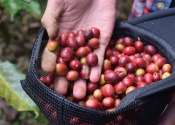
Coffee berries, which contain the coffee bean, are produced by several species of small evergreen bush of the genus Coffea. The two most commonly grown species are Coffea canephora (also known as Coffea robusta) and Coffea arabica; less popular species are Liberica, Excelsa, Stenophylla, Mauritiana, Racemosa. These are cultivated primarily in Latin America, Southeast Asia, and Africa. Once ripe, coffee berries are picked, processed, and dried. The seeds are then roasted, undergoing several physical and chemical changes. They are roasted to varying degrees, depending on the desired flavor. They are then ground and brewed to create coffee. Coffee can be prepared and presented in a variety of ways.

Coffee has played an important role in many societies throughout history. In Africa and Yemen, it was used in religious ceremonies. As a result, the Ethiopian Church banned its secular consumption until the reign of Emperor Menelik II of Ethiopia. It was banned in Ottoman Turkey in the 17th century for political reasons, and was associated with rebellious political activities in Europe.

Coffee is an important export commodity. In 2004, coffee was the top agricultural export for 12 countries, and in 2005, it was the world's seventh-largest legal agricultural export by value.

Some controversy is associated with coffee cultivation and its impact on the environment. Many studies have examined the relationship between coffee consumption and certain medical conditions; whether the overall effects of coffee are positive or negative is still disputed.

For more information about Coffee, read the full article at Wikipedia.
This text uses material from Wikipedia and is available under the GNU Free Documentation License.

Related topics: type 2 diabetes