News tagged with brain cells

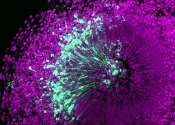
The living fossils of brain evolution

(Phys.org) -- In the course of its evolution, the architecture of the mouse brain may have barely changed. Similar to the tiny ancestors of modern mammals that lived about 80 million years ago, nerve cells ...

Biology / Evolution

created May 23, 2012 | popularity 5 / 5 (2) | comments 0 | with audio podcast

New technique reveals unseen information in DNA code

Imagine reading an entire book, but then realizing that your glasses did not allow you to distinguish "g" from "q." What details did you miss? Geneticists faced a similar problem with the recent discovery ...

Biology / Cell & Microbiology

created May 17, 2012 | popularity 4.8 / 5 (13) | comments 2 | with audio podcast

More light shed on how pigeons navigate

(Phys.org) -- Pigeons are renowned for their ability to find their way home from a release point hundreds of miles away, but scientists have never fully understood how they are able to achieve the feat. Now ...

Biology / Plants & Animals

created Apr 27, 2012 | popularity 4.3 / 5 (3) | comments 1 | with audio podcast report

Immortal worms defy aging

Researchers from The University of Nottingham have demonstrated how a species of flatworm overcomes the ageing process to be potentially immortal.

Biology / Cell & Microbiology

created Feb 27, 2012 | popularity 4.8 / 5 (38) | comments 22 | with audio podcast

New type of extra-chromosomal DNA discovered

(PhysOrg.com) -- A team of scientists from the University of Virginia and University of North Carolina in the US have discovered a previously unidentified type of small circular DNA molecule occurring outside ...

Biology / Biotechnology

created Mar 09, 2012 | popularity 4.8 / 5 (21) | comments 9 | with audio podcast report

Study dusts sugar coating off little-known regulation in cells

In Alzheimer's disease, brain neurons become clogged with tangled proteins. Scientists suspect these tangles arise partly due to malfunctions in a little-known regulatory system within cells. Now, researchers have dramatically ...

Chemistry / Biochemistry

created Apr 16, 2012 | popularity 5 / 5 (2) | comments 1 | with audio podcast

Researchers gain better understanding of mechanism behind tau spreading in the brain

Researchers at Mount Sinai School of Medicine have gained insight into the mechanism by which a pathological brain protein called tau contributes to the progression of Alzheimer's disease (AD) and other neurodegenerative ...

Chemistry / Biochemistry

created May 02, 2012 | popularity not rated yet | comments 1 | with audio podcast

Renowned physicist invents microscope that can peer at living brain cells

(PhysOrg.com) -- Ever since scientists began studying the brain, they’ve wanted to get a better look at what was going on. Researchers have poked and prodded and looked at dead cells under electron microscopes, ...

Physics / General Physics

created Feb 03, 2012 | popularity 4.8 / 5 (20) | comments 7 | with audio podcast report

Discovery of extremely long-lived proteins may provide insight into cell aging

One of the big mysteries in biology is why cells age. Now scientists at the Salk Institute for Biological Studies report that they have discovered a weakness in a component of brain cells that may explain ...

Biology / Cell & Microbiology

created Feb 03, 2012 | popularity 4.9 / 5 (13) | comments 0 | with audio podcast

In lab, Pannexin1 restores tight binding of cells that is lost in cancer

First there is the tumor and then there's the horrible question of whether the cancerous cells will spread. Scientists increasingly believe that the structural properties of the tumor itself, such as how tightly ...

Chemistry / Biochemistry

created Jan 30, 2012 | popularity 5 / 5 (1) | comments 0 | with audio podcast

New method pinpoints important gene-regulation proteins

A novel technique has been developed and demonstrated at Penn State University to map the proteins that read and regulate chromosomes -- the string-like structures inside cells that carry genes. The specific ...

Biology / Cell & Microbiology

created Jan 18, 2012 | popularity 5 / 5 (3) | comments 0 | with audio podcast

Researchers find gene critical to sense of smell in fruit fly

(Medical Xpress) -- Fruit flies don't have noses, but a huge part of their brains is dedicated to processing smells. Flies probably rely on the sense of smell more than any other sense for essential activities ...

Biology / Biotechnology

created Jan 19, 2012 | popularity 3 / 5 (1) | comments 0 | with audio podcast

Protein complex affects cells' ability to move, respond to external cues

In a paper published today in the journal, Cell, a team from the University of North Carolina at Chapel Hill has explained for the first time how a long-studied protein complex affects cell migration and how external cues a ...

Biology / Cell & Microbiology

created Mar 01, 2012 | popularity not rated yet | comments 0 | with audio podcast

A whole new meaning for thinking on your feet

Smithsonian researchers report that the brains of tiny spiders are so large that they fill their body cavities and overflow into their legs. As part of ongoing research to understand how miniaturization affects ...

Biology / Plants & Animals

created Dec 12, 2011 | popularity 4.9 / 5 (9) | comments 3 | with audio podcast

Trojan horse bacteria use nanobodies to conquer sleeping sickness

Sleeping sickness, caused by the trypanosome Trypanosoma brucei, is transmitted to humans (and animals) via the bite of the tsetse fly. New research published in BioMed Central's open access journal Microbial Cell Factories ...

Biology / Cell & Microbiology

created Feb 14, 2012 | popularity 5 / 5 (1) | comments 0

Brain cell

Brain cell is a generic term for the neurons and glial cells. Neurons are nerve cells that process and transmit information through the nervous system. Glial cells provide support, protection, and nutrition to the neurons. Other cells in the brain include epithelial cells that make up the lining of the blood vessels.

Brain cells are commonly thought to remain in the beginning stage of interphase of cell reproduction for their life, and never divide, and instead develop by forming new synapses with other neurons. However, a landmark study in 1998 by researchers from Sweden and the Salk Institute in La Jolla, California, showed for the first time that some brain cells in mature humans may regenerate under certain circumstances.

For more information about Brain cell, read the full article at Wikipedia.
This text uses material from Wikipedia and is available under the GNU Free Documentation License.