How to see the International Space Station
The International Space Station is one of the most complicated machines ever built and the largest object ever assembled in space.
These days, aerospace engineering is all about the light stuff: building airplanes with lighter wings, fuselage and landing gear in an effort to reduce fuel costs.
An Ecuadoran satellite launched last month could collide with the remains of a Russian rocket in the coming hours, the country's civilian space agency warned.
(Phys.org) —Scott Hubbard, a consulting professor of aeronautics and astronautics, helped guide the Kepler mission when he served as director of NASA Ames Research Center. He explains how NASA might bring ...
A former army helicopter pilot was on Monday named as the first "home-grown" British astronaut to head to the International Space Station.
(Phys.org) —The International Space Station has decided to switch dozens of laptops running Windows XP over to Debian. What Linux fans have been saying for years—that Linux delivers greater stability ...
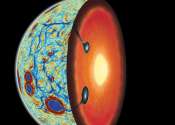
(Phys.org) —A multi-disciplinary team of international researchers has found evidence to suggest the moon's dynamo persisted until at least 3.6 billion years ago. In their paper published in the Proceedings of ...
Astronauts made a rare, hastily planned spacewalk to fix a serious ammonia leak at the International Space Station, and the U.S. space agency said it appeared the repair was a success.
You get into your car and ask it to get you home in time for the start of the big game, stopping off at your favorite Chinese restaurant on the way to grab some takeout.
Landing astronauts safely on Mars is one of the biggest technological hurdles for any future manned mission to the Red Planet, even more complicated than last year's daring rover touchdown.
An impromptu spacewalk over the weekend seems to have fixed a big ammonia leak at the International Space Station, NASA said Thursday.
When a current passes between two electrodes—one thinner than the other—it creates a wind in the air between. If enough voltage is applied, the resulting wind can produce a thrust without the help of ...
Two astronauts will venture outside the International Space Station on Saturday to tackle an ammonia leak in the power cooling system.
(Phys.org) —A test version of NASA's Orion spacecraft safely landed during a simulation of two types of parachute failures Wednesday.
The privately bankrolled Dragon capsule made a historic arrival at the International Space Station on Friday, triumphantly captured by astronauts wielding a giant robot arm.