Shattered glass: New theory explains how things break
(Phys.org) —Shattering a glass is a completely different experience than breaking a seashell, and Cornell physicists offer a notion – at the microscale – to explain why.
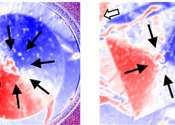
(Phys.org) —Using computer models, a graduate student at the University of Arkansas has collaborated with scientists in the United States and Europe to observe a new magnetic state of bismuth ferrite.
A quantum computer is controlled by the laws of quantum physics; it promises to perform complicated calculations, or search large amounts of data, at a speed that exceeds by far those that today's fastest supercomputers are ...
(Phys.org) —Anyone who has flown in an airplane knows about turbulence, or when the flow of a fluid—in this case, the flow of air over the wings—becomes chaotic and unstable. For more than a century, ...
(Phys.org) —Scientists have discovered how to measure greenhouse gases 200,000 times faster as the result research by an award-winning PhD student from The University of Western Australia and a US team.
(Phys.org) —Squeeze a piece of silicone and it quickly returns to its original shape, as squishy as ever. But scientists at Rice University have discovered that the liquid crystal phase of silicone becomes ...
A longstanding joke holds that practical fusion power is about 20 years away—and always will be. One simple phenomenon explains why practical, self-sustaining fusion reactions have proved difficult to achieve: Turbulence ...
(Phys.org) —Researchers from Princeton University in the U.S. together with colleagues from Zhejiang University of Science and Technology in China have developed a new kind of atomic magnetometer that is ...
(Phys.org) —Those drops on the outside of your drink don't just make the can slippery. Experiments show that in hot, humid weather, condensation heats a drink more than the surrounding air.
With the help of a solitary sea squirt, scientists have resolved the longstanding puzzle of the crystal structure of vaterite, an enigmatic geologic mineral and biomineral.
(Phys.org) —A dramatic leap forward in the ability of scientists to study the structural states of macromolecules such as proteins and nanoparticles in solution has been achieved by a pair of researchers ...
(Phys.org) —The design of the ITER blanket system, a crucial technology on the way to fusion power, has been approved and is now ready to proceed to the manufacturing stage. "The development and validation ...
(Phys.org) —Researchers at TU Delft in the Netherlands have managed to bring two electrons, three meters from each other, into a quantum- entangled state. This result marks a major step towards realizing ...
Streetlights illuminate the night, shining upon roadways and sidewalks across the world, but these ubiquitous elements of the urban environment are notoriously inefficient and major contributors to light ...
(Phys.org) —An international team of researchers succeeds in generating flashes of extreme ultraviolet radiation via the reflection from a mirror that moves close to the speed of light.