Permanent ice fields are resisting global warming
May 16, 2007

Permanent ice fields are resisting global warming

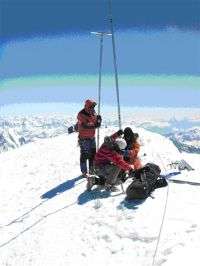
Researchers from the Glaciology Laboratory taking an ice core sample on top of Mont Blanc, in 2005. © C. Vincent, CNRS 2007

The small ice caps of Mont Blanc and the Dôme du Goûter are not melting, or at least, not yet. This is what CNRS researchers have announced in the Journal of Geophysical Research. At very high altitudes (above 4200 meters), the accumulation of snow and ice has varied very little since the beginning of the 20th century. But if summer temperatures increase by a few degrees during the 21st century, the melt could become more marked, and could affect the "permanent" ice fields.

Alpine glaciers, which are mainly at an altitude between 2000 and 4000 meters, shrank considerably during the 20th century and particularly during the past twenty years, losing an average of 1 to 1.5 kilometers in length. However, the situation is different above 4200 meters.

At the altitude of the Dôme du Goûter (4300 m) or the summit of Mont Blanc (4810 m), all precipitation is solid, falling as snow. The ice fields melt very little, and only in extreme conditions such as the 2003 heatwave. Variations in the mass of glaciers only depend on the accumulation of snow and the downward flow of the glacier, as the ice is deformed under its own weight.

In order to study these mass balance fluctuations, the research team measured the rate of accumulation of snow on the Dôme du Goûter since 1993, and the thickness and flow rate of the glacier. They also used meteorological data from Chamonix, from 1923 to the present day, to calculate the rate of accumulation of ice during the 20th century. Or, more precisely, they used data on the precipitation in Chamonix, altitude 1036 meters, to extrapolate for quantities of snow fallen on the glacier, and so to calculate the mass balance.

Based on this data, the glaciologists have shown that at these very high altitudes, the ice mass balance has remained almost constant over the last 100 years. They have also used old topographical maps to show that the thickness of these small ice caps on Mont Blanc and the nearby Dôme du Goûter has only changed by a few meters from 1905 to 2005. By comparison, at a lower altitude (1800 meters), the thickness of the Mer de Glace has decreased by 120 meters over the same period.

So the Mont Blanc and Dôme du Goûter ice fields have not yet been affected by climate change. However, during exceptional climatic events like the 2003 heatwave, positive temperatures caused some of the surface ice to melt. If episodes like this were to occur more often, this partial melting would no longer be negligible, and would have a significant effect on the ice mass. So there is no guarantee that "permanent" ice fields will stay that way in the future.

Source: CNRS

3.3 /5 (3 votes)  

Rank 3.3 /5 (3 votes)
Tags

Relevant PhysicsForums posts

More news stories

Land and sea species differ in climate change response: study

(Phys.org) -- Marine and terrestrial species will likely differ in their responses to climate warming, new research by Simon Fraser University and Australia’s University of Tasmania has found.

Space & Earth / Environment

created 7 hours ago | popularity 3.8 / 5 (4) | comments 5 | with audio podcast

Yale study concludes public apathy over climate change unrelated to science literacy

Are members of the public divided about climate change because they don't understand the science behind it? If Americans knew more basic science and were more proficient in technical reasoning, would public consensus match ...

Space & Earth / Environment

created 9 hours ago | popularity 4.8 / 5 (5) | comments 20 | with audio podcast

10 million years needed to recover from mass extinction

It took some 10 million years for Earth to recover from the greatest mass extinction of all time, latest research has revealed.

Space & Earth / Earth Sciences

created 9 hours ago | popularity 4 / 5 (4) | comments 1 | with audio podcast

Sophisticated simulations predict future warming

The chances of our planet being hit by a global warming of 3 degrees Celsius by 2050 is as likely as it being hit by an increase of 1.4 degrees, new research shows. Presented in the journal Nature Geoscience, the British study ...

Space & Earth / Earth Sciences

created May 22, 2012 | popularity 3.8 / 5 (11) | comments 51

Aliens don't want to eat us, says former SETI director

Alien life probably isn’t interested in having us for dinner, enslaving us or laying eggs in our bellies, according to a recent statement by former SETI director Jill Tarter.

Space & Earth / Space Exploration

created May 25, 2012 | popularity 4.4 / 5 (15) | comments 41


Stunning image of smallest possible five-ringed structure

Scientists have created and imaged the smallest possible five-ringed structure – about 100,000 times thinner than a human hair – and you'll probably recognise its shape.

'Unzipped' carbon nanotubes could help energize fuel cells, batteries

Multi-walled carbon nanotubes riddled with defects and impurities on the outside could replace some of the expensive platinum catalysts used in fuel cells and metal-air batteries, according to scientists at ...

Change in developmental timing was crucial in the evolutionary shift from dinosaurs to birds: study

At first glance, it's hard to see how a common house sparrow and a Tyrannosaurus Rex might have anything in common. After all, one is a bird that weighs less than an ounce, and the other is a dinosaur that ...

Computer model used to pinpoint prime materials for efficient carbon capture

When power plants begin capturing their carbon emissions to reduce greenhouse gases – and to most in the electric power industry, it's a question of when, not if – it will be an expensive undertaking.

T cells 'hunt' parasites like animal predators seek prey, study shows

By pairing an intimate knowledge of immune-system function with a deep understanding of statistical physics, a cross-disciplinary team at the University of Pennsylvania has arrived at a surprising finding: T cells use a movement ...

Scientists develop ultra-sensitive test that detects diseases in their earliest stages

Scientists have developed an ultra-sensitive test that should enable them to detect signs of a disease in its earliest stages, in research published today in the journal Nature Materials.