Extreme winds rule exoplanet's weather
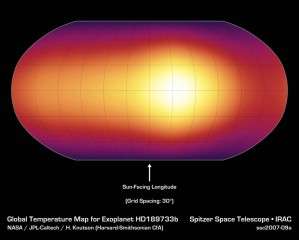
Global Temperature Map for Exoplanet HD189733b - Scientists used data from the Spitzer Space Telescope to map temperatures on this 'hot Jupiter' orbiting 60 light years away from Earth. UA scientists calculated supersonic wind speeds for this exoplanet. Image credit: NASA/JPL-Caltech/H. Knutson, Harvard-Smithsonian CfA
Supersonic winds more than six times faster than those on Jupiter are blasting through the atmosphere of a Jupiter-sized planet 60 light years away, say scientists who've analyzed results from NASA's Spitzer Space Telescope.
They're part of a team that mapped weather on a planet beyond our solar system, a gas giant planet called HD 189733b.
"The exoplanet's wind speeds probably exceed the speed of sound," said Adam Showman of the University of Arizona Lunar and Planetary Laboratory (LPL). "And the speed of sound on these planets is 10 times faster than on Earth, so that's saying something." The speed of sound in HD 189733b's atmosphere is about 3 kilometers per second (6,700 mph).
Showman and LPL research associate Curtis Cooper analyzed Spitzer data on planet HD 189733b using the numerical models they've been developing for exoplanet atmospheres. The planet, which is in constellation Vulpecula, is the closest known 'transiting' planet. A transiting planet is seen to cross in front and behind its star when viewed from Earth. The planet is "tidally locked" to its star, so that one side always faces the star and the other side is always dark, just as the moon is tidally locked to the Earth.
A team led by Heather Knutson of the Harvard-Smithsonian Center for Astrophysics, Cambridge, Mass., used the Spitzer Space Telescope to measure the infrared light, or heat, as the planet orbited its sun-like star. The result is one of the first-ever temperature maps for an exoplanet. The map shows that dayside and nightside temperatures differ only by about 500 degrees Fahrenheit, ranging from 1,200 degrees F on the nightside to 1,700 degrees F on the dayside.
"At these high temperatures, air cools off rapidly when it moves from the dayside to the nightside," Showman said. "That relatively small temperature difference implies that fierce winds redistribute a lot of the heat."
"We need to do more detailed modeling to calculate actual wind speeds. At this stage, the numbers are all quite uncertain," he said. "However, we can be certain the speeds are FAST, probably a couple of kilometers per second," or about 4,500 mph. The supersonic exoplanet winds might be as great as 10 kilometers per second, or about 22,000 mph, the UA researchers calculate.
"This isn't just the case where you need winds, but winds that are fast enough to move air from one side of the gas giant planet to the other before it has time to cool off," Showman said.
"We might have a situation where the winds are moving faster than the rotating planet itself because 'hot Jupiters' like this one rotate slowly," Showman said. The hot Jupiter exoplanet rotates at about 2 kilometers per second (about 4,500 mph) at its equator.
Earth and Jupiter's winds are anemic, by comparison. The Earth is spinning at almost 1,000 mph at its equator. A given point at Earth's equator rotates through Earth's 25,000 mile circumference in 24 hours. But its wind speeds are only around 20 to 200 mph. The same is true on Jupiter. Jupiter's equator rotates at almost 27,000 mph, but its wind speeds are only around 70 to 340 mph.
Cooper's and Showman's numerical simulations predicted a larger difference between dayside and nightside temperatures, so winds on exoplanet HD 189733b are more complex than their models currently reflect, Showman said.
But their simulations match the observations in some other respects. One of their predictions is that the winds distort the temperature pattern, blowing the hottest region downwind from the locations that get maximum starlight. "The exoplanet doesn't emit its greatest energy toward Earth when aimed at Earth," Showman said. "As our models predict, the hottest point is seen a couple of hours before the planet passes behind the star."
Source: University of Arizona
-
From lemons to lemonade: Reaction uses carbon dioxide to make carbon-based semiconductor,
32 comments
-
Thioridazine kills cancer stem cells in human while avoiding toxic side-effects of conventional cancer treatments,
3 comments
-
SpaceX private rocket blasts off for space station (Update),
42 comments
-
Climate scientists say they have solved riddle of rising sea,
31 comments
-
SpaceX capsule has 'new car' smell, astronauts say (Update),
4 comments
-
Distance of planets from stars and revolution
11 hours ago
-
revamping general concept and cosmological principle
May 25, 2012
-
Transiting Exoplanet Light Curve
May 25, 2012
-
Math behind Theoretical Physics
May 24, 2012
-
Do we know whats at the center of galaxies yet?
May 23, 2012
-
Structure of the Milky Way?
May 20, 2012
- More from Physics Forums - General Astronomy
More news stories
Land and sea species differ in climate change response: study
(Phys.org) -- Marine and terrestrial species will likely differ in their responses to climate warming, new research by Simon Fraser University and Australia’s University of Tasmania has found.
8 hours ago |
4 / 5 (5) |
6
|
Yale study concludes public apathy over climate change unrelated to science literacy
Are members of the public divided about climate change because they don't understand the science behind it? If Americans knew more basic science and were more proficient in technical reasoning, would public consensus match ...
10 hours ago |
4.8 / 5 (6) |
26
|
10 million years needed to recover from mass extinction
It took some 10 million years for Earth to recover from the greatest mass extinction of all time, latest research has revealed.
Space & Earth / Earth Sciences
10 hours ago |
4.2 / 5 (5) |
2
|
Sophisticated simulations predict future warming
The chances of our planet being hit by a global warming of 3 degrees Celsius by 2050 is as likely as it being hit by an increase of 1.4 degrees, new research shows. Presented in the journal Nature Geoscience, the British study ...
Space & Earth / Earth Sciences
May 22, 2012 |
3.8 / 5 (11) |
51
Aliens don't want to eat us, says former SETI director
Alien life probably isnt interested in having us for dinner, enslaving us or laying eggs in our bellies, according to a recent statement by former SETI director Jill Tarter.
Space & Earth / Space Exploration
May 25, 2012 |
4.4 / 5 (15) |
41
'Unzipped' carbon nanotubes could help energize fuel cells, batteries
Multi-walled carbon nanotubes riddled with defects and impurities on the outside could replace some of the expensive platinum catalysts used in fuel cells and metal-air batteries, according to scientists at ...
Change in developmental timing was crucial in the evolutionary shift from dinosaurs to birds: study
At first glance, it's hard to see how a common house sparrow and a Tyrannosaurus Rex might have anything in common. After all, one is a bird that weighs less than an ounce, and the other is a dinosaur that ...
Computer model used to pinpoint prime materials for efficient carbon capture
When power plants begin capturing their carbon emissions to reduce greenhouse gases and to most in the electric power industry, it's a question of when, not if it will be an expensive undertaking.
T cells 'hunt' parasites like animal predators seek prey, study shows
By pairing an intimate knowledge of immune-system function with a deep understanding of statistical physics, a cross-disciplinary team at the University of Pennsylvania has arrived at a surprising finding: T cells use a movement ...
Stunning image of smallest possible five-ringed structure
Scientists have created and imaged the smallest possible five-ringed structure about 100,000 times thinner than a human hair and you'll probably recognise its shape.
Browser wars flare in mobile space
The browser wars are heating up again, but this time the fight is for dominance of the mobile Internet.