Geologists to test theory that Asia is being 'stuffed' under Tibetan Plateau
May 04, 2007
Geologists to test theory that Asia is being 'stuffed' under Tibetan Plateau
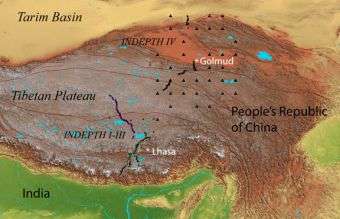
A map of Tibet that shows the progression of Project INDEPTH, a seismic surveying expedition. Credit: Larry Brown

For nearly a decade and a half, Cornell geologist Larry Brown has been leading an international seismic profiling effort in Tibet, using explosions to probe the deep earth and discover how continents formed millions of years ago.

The project, called INDEPTH -- for International Deep Profiling of Tibet and the Himalayas -- has gone through several stages and now is a major international collaboration among scientists from the United States, China, Germany, Canada and, most recently, Ireland.

The National Science Foundation recently renewed funding for the project with a grant of $1.3 million to Cornell to finish the survey. Brown, professor of earth and atmospheric sciences, has been leading the project across the Tibetan plateau, located in the southwestern corner of China, since its inception in the early 1990s.

Tibet is one of the world's best examples of what happens when continents smash together, Brown explained, because of its famously high elevation and sprawling terrain. The Himalayas are thought to be have formed when the Indian continent slammed into Asia beginning about 50 million years ago.

The ultimate goal, according to Brown, is to piece together what happens when continents collide to form supercontinents like Eurasia. A common theory is that the Tibetan Plateau formed when India was pushed under Asia from the south.

"We'll be testing the hypothesis that, in fact, Asia is also being stuffed under the northern part of the plateau," Brown said.

In order to do that, scientists must understand the geometry of rock layers under the Earth's surface.

The researchers use echo sounding, which is the same basic technology used to map the ocean bottom and explore for oil and gas. In Tibet, the scientists set up explosions that generate sound waves, whose echoes off the deep rock layers are recorded and analyzed.

This allows an "acoustic photograph" to be taken as deep as 100 miles, but typically between 20 and 30 miles deep, said Brown, whose current work also involves deep imaging of major earthquake faults in Taiwan and an active volcano on the Caribbean island of Montserrat.

Future targets of Brown's work include sites in Brazil, Africa, Madagascar and India.

Source: Cornell University

Explore further: Astonishing hi-resolution satellite views of the destruction from the Moore, Oklahoma tornado

add to favorites email to friend print save as pdf

Related Stories

Ancestry of polar bears traced to Ireland

Jul 07, 2011

An international team of scientists has discovered that the female ancestor of all living polar bears was a brown bear that lived in the vicinity of present-day Britain and Ireland just prior to the peak of ...

Old dog, new tricks: Study IDs 9,400-year-old mutt

Jan 19, 2011

Nearly 10,000 years ago, man's best friend provided protection and companionship - and an occasional meal. That's what researchers are saying after finding a bone fragment from what they are calling the earliest ...

Early Christmas treat: 2010's total lunar eclipse

Dec 19, 2010

(AP) -- 'Twill be nights before Christmas and high overhead, the moon will turn brown or maybe deep red. The Earth and the sun with celestial scripts will conspire to make a lunar eclipse.

Recommended for you

Strong earthquake at exceptional depth

20 hours ago

This morning at 05:45 CEST, the earth trembled beneath the Okhotsk Sea in the Pacific Northwest. The quake, with a magnitude of 8.2, took place at an exceptional depth of 605 kilometers. Because of the great ...

Marine forecasting on the horizon for Indian Ocean Rim

20 hours ago

Nearly all of the member countries of the Indian Ocean Rim Association for Regional Cooperation (IOR-ARC) will attend the week-long workshop to further cooperation and understanding on international ocean ...

Russia evacuates drifting Arctic research station

May 23, 2013

Russia has ordered the urgent evacuation of the 16-strong crew of a drifting Arctic research station after ice floe that hosts the floating laboratory began to disintegrate, officials said Thursday.

User comments : 0

More news stories

Galaxies fed by funnels of fuel

(Phys.org) —Computer simulations of galaxies growing over billions of years have revealed a likely scenario for how they feed: a cosmic version of swirly straws.

Source of life running out: water scientists

The majority of people on Earth people will face severe water shortages within a generation or two if pollution and waste continues unabated, scientists warned at a conference in Bonn Friday.

Dark, massive asteroid to fly by Earth on May 31

It's 1.7 miles long. Its surface is covered in a sticky black substance similar to the gunk at the bottom of a barbecue. If it impacted Earth it would probably result in global extinction. Good thing it is ...