Cheap source of energy: Cell splits water via sunlight to produce hydrogen
May 01, 2007 By Tony Fitzpatrick
Cell splits water via sunlight to produce hydrogen
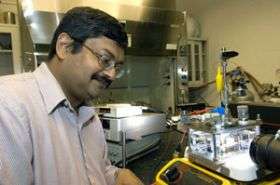
Pratim Biswas and his group have developed a method to make a variety of oxide semiconductors that, when put into water promote chemical reactions that split water into hydrogen and oxygen. The method provides a new low cost and efficient option for hydrogen production. Credit: David Kilper/WUSTL Photo

Engineers at Washington University in St. Louis have developed a unique photocatalytic cell that splits water to produce hydrogen and oxygen in water using sunlight and the power of a nanostructured catalyst.

The group is developing novel methodologies for synthesis of nanostructured films with superior opto-electronic properties. One of the methods, which sandwiches three semiconductor films into a compact structure on the nanoscale range, is smaller, more efficient and more stable than present photocatalytic methods, which require multiple steps and can take from several hours to a day to complete.

The discovery provides a new, low-cost and efficient option for hydrogen production and can be used for a variety of distributed energy applications.

Pratim Biswas, Ph.D., the Stifel and Quinette Jens Professor and Chair of the Department of Energy, Environmental and Chemical Engineering, and his graduate student Elijah Thimsen, recently have developed the well-controlled, gas phase process, and have demonstrated it for synthesizing a variety of oxide semiconductors such as iron and titanium dioxide films in a single step process. It is based on a simple, inexpensive flame aerosol reactor (FLAR) and consists of four mass flow controllers to regulate process gases, a standard bubbler to deliver a precursor, a metal tube that acts as a burner and a water-cooled substrate holder.

"We put these films in water and they promote some reactions that split water into hydrogen and oxygen," said Biswas. "We can use any oxide materials such as titanium dioxide, tungsten oxide and iron oxide in nanostructures sandwiched together that make very compact structures. The process is direct and takes only a few minutes to fabricate. More important, these processes can be scaled up to produce larger structures in a very cost effective manner in atmospheric pressure processes."

Collaborations have now been established with Dewey Holten, Ph.D., Washington University professor of chemistry in Arts & Sciences, to better understand the electron-hole pair kinetics, information that can then be used to tune the synthesis process. Other collaborations with Robert Blankenship, Ph.D., Washington University professor of biology and chemistry in Arts & Sciences, are being explored to create hybrid bio-nanostructures that will improve the light absorption efficiencies over a broader range of wavelengths. Electrospray and other aerosol techniques are being used to create these hybrid films.

The method was described in a recent issue of SPIE, a publication of the International Society for Optical Engineering.

The research is among the first wave of news out of the new Washington University Department of Energy, Environmental and Chemical Engineering, which performs research on energy and environment, including alternative fuels and energy sources, air quality research, nanoparticle technology and particle emission control, among other topics.

Some of the department faculty — 14 members now, expected to double in five to ten years — are active in the University's ambitious BioEnergy Initiative, which is focused on the development of technologies for the production of next generation biofuels. The adoption of a systems approach will not only enable development processes for large volume production of liquid fuels from plant-based sources, but also at a low cost, and most importantly, in an environmentally benign manner — not only during the production, but also during the actual usage.

Source: Washington University in St. Louis

Explore further: Attacking MRSA with metals from antibacterial clays

add to favorites email to friend print save as pdf

Related Stories

New magnetic graphene may revolutionise electronics

May 10, 2013

Researchers from IMDEA-Nanociencia Institute and from Autonoma and Complutense Universities of Madrid (Spain) have managed to give graphene magnetic properties. The breakthrough, published in the journal ...

Microwave oven cooks up solar cell material

May 06, 2013

University of Utah metallurgists used an old microwave oven to produce a nanocrystal semiconductor rapidly using cheap, abundant and less toxic metals than other semiconductors. They hope it will be used ...

Recommended for you

Attacking MRSA with metals from antibacterial clays

May 17, 2013

In the race to protect society from infectious microbes, the bugs are outrunning us. The need for new therapeutic agents is acute, given the emergence of novel pathogens as well as old foes bearing heightened antibiotic resistance.

Beautiful 'flowers' self-assemble in a beaker

May 16, 2013

By simply manipulating chemical gradients in a beaker of fluid, materials scientists at Harvard have found that they can control the growth behavior of crystals to create precisely tailored structures—such ...

Reading the unreadable

May 16, 2013

Pioneering X-ray technology is making it possible to read fragile rolled-up historical documents for the first time in centuries.

Keeping fruit, vegetables and cut flowers fresh longer

May 15, 2013

New technology offers the promise of reducing billions of dollars of losses that occur each year from the silent, invisible killer of fruits, vegetables and cut flowers—a gas whose effects are familiar to everyone who has ...

User comments : 0

More news stories

Attacking MRSA with metals from antibacterial clays

In the race to protect society from infectious microbes, the bugs are outrunning us. The need for new therapeutic agents is acute, given the emergence of novel pathogens as well as old foes bearing heightened antibiotic resistance.

Beautiful 'flowers' self-assemble in a beaker

By simply manipulating chemical gradients in a beaker of fluid, materials scientists at Harvard have found that they can control the growth behavior of crystals to create precisely tailored structures—such ...

Making gold green: New non-toxic method for mining gold

Northwestern University scientists have struck gold in the laboratory. They have discovered an inexpensive and environmentally benign method that uses simple cornstarch—instead of cyanide—to isolate gold from raw materials ...

German energy shift faces headwinds

Tense engineers have their eyes peeled on complex colour-coded diagrams on a wall-sized screen that makes their control room look like the inside of a spaceship.

Russia retrieves mice, newts from space

A Russian capsule filled with 45 mice and 15 newts along with other small animals returned from a month's mission in orbit on Sunday with data scientists hope will pave the way for a manned flight to Mars.

Honeybees trained in Croatia to find land mines

(AP)—Mirjana Filipovic is still haunted by the land mine blast that killed her boyfriend and blew off her left leg while on a fishing trip nearly a decade ago. It happened in a field that was supposedly ...