Scientists target manta ray mysteries
May 01, 2007
Scientists target manta ray mysteries
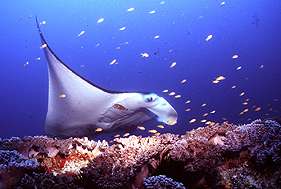
Manta rays are one of the ocean's mysteries. Photo: Andrea Marshall

Manta rays are hard to miss —big, black and stretching up to seven metres wide, but scientists are still in the dark about the world's largest ray.

A team of UQ scientists is joining forces with industry and government partners to launch the most comprehensive study of manta rays yet.

Project Manta will detail manta ray populations, their behaviours, feeding patterns, movements, migrations using observations and satellite imagery and will identify individuals via DNA and photographic analysis.

One of the project's lead scientists, Dr Kathy Townsend, said little was known about manta rays, which were listed as vulnerable by the World Conservation Union.

“Manta rays are a big ecotourism drawcard, forming the basis of multimillion dollar industries around the globe,” Dr Townsend said.

“Our research focuses on the population of manta rays along the eastern seaboard of Australia and includes Moreton Bay and the Great Barrier Reef Marine Park.

“Surprisingly, basic information about their population, lifespan, migrations and breeding information remains unknown.”

Dr Townsend said local divers and snorkellers, some with 20 years of diving photos, would be involved in creating an image database to identify manta rays.

“We specifically want the pictures of the underbelly of the manta ray because this can be used to identify individuals,” she said.

“The black and white pattern is as unique as a fingerprint.”

She said much of the research work would start in October when the manta rays returned to Moreton Bay Marine Park.

Fellow lead scientists,Associate Professor Mike Bennett and Dr Scarla Weeks said the project built on a four-year-study of the world's largest known manta ray population off the Mozambican coast by UQ PhD student Andrea Marshall.

“We are in a unique position of having over a decade's worth of data on Australian, African and Japanese manta ray populations which together with satellite imagery, will allow us to address many questions about the rays' biology,” Associate Professor Bennett said.

Project Manta will also address the broader issues of the effect of climate change on the marine environment.

“Understanding the manta ray's feeding activities, movements and migrations in relation to oceanic conditions will allow us to use this highly visible species as a biological indicator of ecosystem impacts resulting from climate change,” Dr Weeks said.

Dr Townsend said the project had support from Consolidated Rutile Limited (CRL), South East Queensland Catchment, Lady Elliott Eco Resort, Undersea Explorer and Bounty Divers from Norfolk Island.

“Manta rays are a key drawcard for divers and naturalists and generally all of those that use Moreton Bay and the Great Barrier Reef Marine Park,” CRL Environment and Community Relations Manager Paul Smith said.

“By sponsoring research into this animal that lives right on our doorstep, we can assist not just manta rays, but the marine environment for future generations.”

Source: University of Queensland

Explore further: Researcher admits mistakes in stem cell study

add to favorites email to friend print save as pdf

Related Stories

New Caledonia bans shark fishing

Apr 24, 2013

The government of the Pacific paradise of New Caledonia said Wednesday it had decided to ban fishing of sharks, which are being decimated to feed growing demand for luxury goods.

Mapping lava tubes in the Galapagos

Apr 08, 2013

(Phys.org) —Yearly expeditions to explore the lava tubes on the famed archipelago will culminate in an international symposium to be held there next year.

Opponents fail to overturn shark-protection deal

Mar 14, 2013

Japan, China and other nations that support shark fishing lost a bid to overturn a landmark deal that offers global trade protection for several species of the ocean's oldest predator.

Japan tsunami town on watch for shark deal

Mar 13, 2013

An international agreement to protect sharks could spell trouble for one tsunami-wrecked port in Japan as it struggles back to its feet two years after being swept away, locals say.

Recommended for you

Researcher admits mistakes in stem cell study

12 hours ago

A blockbuster study in which US researchers reported that they had turned human skin cells into embryonic stem cells contained errors, its lead author has acknowledged. ...

Scientists discover how rapamycin slows cell growth

14 hours ago

University of Montreal researchers have discovered a novel molecular mechanism that can potentially slow the progression of some cancers and other diseases of abnormal growth. In the May 23 edition of the prestigious journal ...

Bittersweet: Bait-averse cockroaches shudder at sugar

16 hours ago

Sugar isn't always sweet to German cockroaches, especially to the ones that avoid roach baits. In a study published May 24 in the journal Science, North Carolina State University entomologists show the ne ...

User comments : 0

More news stories

White tiger mystery solved

White tigers today are only seen in zoos, but they belong in nature, say researchers reporting new evidence about what makes those tigers white. Their spectacular white coats are produced by a single change ...

Controlling mood through the motions of mitochondria

(Medical Xpress)—Regulating the distribution of power in neurons is done by a system that makes the national electric grid look simple by comparison. Each neuron has several thousand mitochondria confined ...

Hormone replacement therapy—clarity at last

The British Menopause Society and Women's Health Concern have today released updated guidelines on Hormone Replacement Therapy (HRT) to provide clarity around the role of HRT, the benefits and the risks. The new guidelines ...

A hidden population of exotic neutron stars

(Phys.org) —Magnetars – the dense remains of dead stars that erupt sporadically with bursts of high-energy radiation - are some of the most extreme objects known in the Universe. A major campaign using ...