New nanocomposites may mean more durable tooth fillings
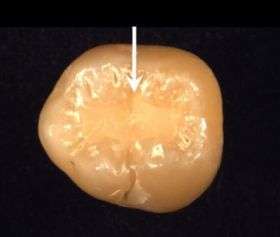
The mouth is a tough environment—which is why dentists do not give lifetime guarantees. Despite their best efforts, a filling may eventually crack under the stress of biting, chewing and teeth grinding, or secondary decay may develop where the filling binds to the tooth. Fully 70 percent of all dental procedures involve replacements to existing repairs, at a cost of $5 billion per year in the United States alone.
Now, however, scientists at the American Dental Association’s Paffenbarger Research Center, a joint research program at the National Institute of Standards and Technology, have shown that nanotechnology has the potential to lessen that toll by producing tooth restorations that are both stronger than any decay-fighting fillings available today, and more effective at preventing secondary decay. They report their findings in a recent issue of The Journal of Dental Research.
The researchers’ new technique solves a problem with the standard composite resin filling, a natural-looking restoration that is the method of choice when appearance is an issue. A dentist creates the filling by mixing the pure liquid resin with a powder that contains coloring, reinforcement and other materials, packing the resulting paste into the cavity, and illuminating the tooth with a light that causes the paste to polymerize and harden. For decay-fighting composite fillings, the problem arises from an additive that is included in the powder to provide a steady release of calcium and phosphate ions.
These ions are essential to the long-term success of the filling because they not only strengthen the crystal structure of the tooth itself, but buffer it against the decay-causing acid produced by bacteria in the mouth. Yet the available ion-releasing compounds are structurally quite weak, to the point where they weaken the filling as a whole.
To get around this conundrum, the Paffenbarger researchers have devised a spray-drying technique that yields particles of several such compounds, one of which being dicalcium phosphate anhydrous, or DCPA, that are about 50 nanometers across—20 times smaller than the 1-micrometer particles in a conventional DCPA powder.
Because these nanoscale particles have a much higher surface to volume ratio, they are much more effective at releasing ions, which means that much less of the material is required to produce the same effect. That, in turn, leaves more room in the resin for reinforcing fibers that strengthen the final filling. To exploit that opportunity, the Paffenbarger researchers also have developed nanoscale silica-fused fibers that produce a composite resin nearly twice as strong as the currently available commercial variety.
Citation: H.H.K. Xu, M.D. Weir, L. Sun, S. Takagi and L.C. Chow. Effects of calcium phosphate nanoparticles on Ca-PO4 composite, J Dent Res 86(4):378-383m 2007.
Source: National Institute of Standards and Technology


