Researchers develop technique for bacteria crowd control
A surprising technique to concentrate, manipulate, and separate a wide class of swimming bacteria has been identified through a collaboration between researchers at Argonne National Laboratory, Illinois Institute of technology, University of Arizona at Tucson, and Cambridge University, UK. This device could have enormous applications in biotechnology and biomedical engineering including use in miniaturized medical diagnostic kits and bioanalysis.
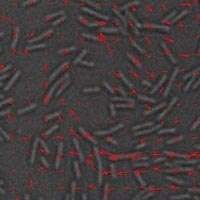
The technique is based on the transmission of tiny electric current in a very thin film sample cell containing a colony of bacteria. The current produces electrolysis that changes the local pH level in the vicinity of the electrodes. The bacteria, uncomfortable with the changes in pH, swim away from the electrodes and ultimately congregate in the middle of the experimental cell. Concentrated bacteria form self-organized swirls and jets resembling vortices in vigorously stirred fluid.
The method, which is suitable for flagellated bacteria such as E.coli, Bacillus subtilis, among many others, relies on the ability of bacteria to swim toward areas of optimal pH level. The bacteria live in an environment of a specific pH level, so that an increase or decrease of pH stimulates the bacteria to avoid areas of non-comfortable pH and swim in the direction of pH gradient. The researchers used an electric current to create a controlled deviation of the pH levels from the bulk values. Since only living bacteria respond to the pH stimulation, using this method can separate living and dead cells or bacteria with different motility.
The device, capable to change the thickness of a film from 1mm to 1 micron (with accuracy of 5 percent) and control the position of electrodes, is intended to separate and concentrate small quantities of live /dead microorganisms in confined spaces. It can be used for the purposes of express bioanalysis, diagnostic, and identification of small bacterial samples, and separation sicken/live cells. A patent for the device is currently pending.
"Using this method, our research succeeded in dramatically increasing the concentration of microorganisms in tiny fluid drops and films. Unlike traditional centrifuging techniques, the new approach allows selective concentration of healthy cells," said Andrey Sokolov, Ph.D. student from Illinois Institute of Technology and contributor to the research.
In addition to the development of the device used in the experimentation, research findings uncovered the explanation for the long-standing fundamental question on the properties of collective and organized motion in the systems of interacting self-moving objects. Besides swimming bacteria, other examples include bird flocks, fish schools, motor proteins in living cell, and even swarms of communicating nano-robots.
"We have presented experimental studies of collective bacterial swimming in thin fluid films where the dynamics are essentially two-dimensional and the concentration can be adjusted continuously," explained Igor Aronson, physicists at Materials Science Division, Argonne National Laboratory. "Our results provide strong evidence for the pure hydrodynamic origin of collective swimming, rather than chemotactic mechanisms of pattern formation when microorganisms just follow gradients of a certain chemical, such as nutrient, Oxygen, or other."
Source: Argonne National Laboratory


