Climate key to species invasion by air
Apr 11, 2007
Climate key to species invasion by air
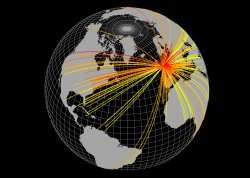
Global air network showing hotspots for invasion of foreign species.

Far-flung regions with similar climates that are suddenly linked by a busy flight route are at an increased risk of an invasion of foreign species, according to scientists at Oxford University.

The new research also identified an ‘invasion window’ across the global air network from June to August when climatic conditions at regions linked by long haul routes are most similar to one another and the higher number of flights increases the chances of exotic species hitching a ride to somewhere new. A report of the study is published in Proceedings of the Royal Society B.

While the spread of invading species once they reach a new area has been extensively studied relatively little work has been done on how such organisms might initially be dispersed and survive. Recently, international air travel has been pinpointed as a significant factor in the movement of economically damaging pest species, with 73% of recorded pest interceptions in the US occurring at airports. For example: the Mediterranean fruit fly has been consistently imported in airline luggage, plant pathogens are often found in air cargo and disease-carrying mosquitoes have survived long haul flights in aircraft cabins.

The Oxford scientists analysed data from over 800 airlines for 12 months (from 1 May 2005 to 30 April 2006) detailing over 3 million flights. They then examined the mean temperature, rainfall and humidity at each region linked by a flight route to see how the global air network provides seasonal links to places with similar climates.

‘When we combined this monthly climate data with information on how busy flight routes were in particular months the results were striking,’ said Dr Andy Tatem of Oxford’s Department of Zoology, who led the work with Dr Simon Hay, ‘the June to August period stood out as the time when the busiest flight routes connect geographically distant but climatically similar locations. This combination potentially increases the overall chances of dispersal and successful invasion of foreign species.’

The research will help airport and government personnel to identify where and when a heightened risk of an invasion of foreign species may occur; enabling them to target their surveillance and control efforts more effectively.

Source: Oxford University

Explore further: US: NYU researchers took bribes from Chinese group

add to favorites email to friend print save as pdf

Related Stories

South Africa: Fight over rhino poaching escalates

Apr 24, 2013

(AP)—A U.S. firm recently gave smart phones to some game rangers in South Africa to help them track poachers who kill rhinos for their horns. An anti-poaching ad campaign in Vietnam, a key illegal market, ...

NASA's HyspIRI: Seeing the forest and the trees and more

Apr 22, 2013

To Robert Green, light contains more than meets the eye: It contains fingerprints of materials that can be detected by sensors that capture the unique set of reflected wavelengths. Scientists have used the ...

Neural activity in bats measured in-flight

Apr 18, 2013

Animals navigate and orient themselves to survive – to find food and shelter or avoid predators, for example. Research conducted by Dr. Nachum Ulanovsky and research student Michael Yartsev of the Weizmann ...

Eye exam for a satellite

Apr 17, 2013

You don't just strap a satellite to a rocket, launch it, and voilà, it takes measurements. Beyond maneuvering into the right orbit, there are a series of check-out procedures to make sure the satellite performs ...

Ice cloud heralds fall at Titan's south pole

Apr 11, 2013

(Phys.org) —An ice cloud taking shape over Titan's south pole is the latest sign that the change of seasons is setting off a cascade of radical changes in the atmosphere of Saturn's largest moon. Made from ...

Bumblebees use logic to find the best flowers

Apr 04, 2013

Scientists at Queen Mary, University of London and the Zoological Society of London (ZSL), have discovered why bees copy each other when looking for nectar – and the answer is remarkably simple.

Recommended for you

US: NYU researchers took bribes from Chinese group

May 20, 2013

Three New York University researchers from China divulged results from a U.S.-funded study to Chinese competitors in exchange for tuition, rent and other expenses, federal prosecutors said Monday.

US scientist not involved in classified research: witnesses

May 17, 2013

Colleagues of a US scientist found hanged in Singapore last year told a coroner's inquiry Friday he was not involved in projects with military applications and was never asked to compromise any country's national security.

User comments : 0

More news stories

The new retirement: No retirement?

For growing numbers of Americans, the new retirement may really mean no retirement. That's the conclusion of an article in the current issue of the ISR Sampler, the annual magazine of the University of Michigan Institute ...

Striking a balance on taxes

Now that April 15 has come and gone, most Americans have turned their attention away from taxes. But MIT student Stefanie Stantcheva continues to ponder the trade-offs associated with taxation.

DNA damage: The dark side of respiration

(Phys.org) —Adventitious changes in cellular DNA can endanger the whole organism, as they may lead to life-threatening illnesses like cancer. Researchers at LMU now report how byproducts of respiration cause mispairing ...