Plasma thruster tested for Mars mission
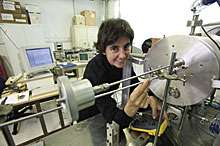
Technology invented by ANU physicists could see expeditions to Mars become a reality, with the European Space Agency (ESA) announcing it will begin full-scale trials next year.
The Helicon Double Layer Thruster (HDLT) technology to be used by the ESA was developed by Dr Christine Charles and Professor Rod Boswell from the Research School of Physical Sciences and Engineering at ANU.
The technology was recently verified at the Ecole Polytechnique in Paris, one of the great research centres in France, under a contract from Dr Roger Walker of the Advanced Concept Team of ESA. The French group was lead by Dr Pascal Chabert who has been collaborating with the ANU group for nearly a decade and has spent many months working with Dr Charles and Professor Boswell.
The HDLT uses solar electricity from the sun to create a magnetic field through which hydrogen is passed to make a beam of plasma, powering ships through space.
While the plasma thruster has a fraction of the power of the rockets that launch the space shuttle, it uses far less fuel and gets more thrust as a ratio of the fuel it burns, making it ideal for interplanetary missions.
“The next space race is to get to Mars — this is a safe technology to take them there,” Dr Charles said.
The popularity of plasma thrusters has only taken off in recent years, particularly for helping satellites maintain their orbits. However, NASA’s VASIMR concept and the ANU HDLT are recent developments that may open the door to deep space exploration.
The physics behind the HDLT technology is based on the northern and southern aurorae, natural phenomena that occur when electrified gas released by the Sun hits the magnetic field of the Earth and creates a boundary of two plasma layers. Electrically charged particles pick up energy as they travel through the layers of different electrical properties, thereby creating thrust as they leave the spacecraft.
Dr Charles and Professor Rod Boswell first created spontaneous current-free plasma double layers in their laboratory in 2003 and realised their accelerating properties could enable new electrode-free spacecraft thrusters. This led the group to develop the Helicon Double Layer Thruster.
Dr Charles says the ANU thruster has the edge on rival technologies as it is simpler and has been proven to work with many propellants including hydrogen, a waste product of human habitation.
“The HDLT is a beautiful piece of physics because it is so simple and has an almost infinite lifetime. It doesn’t need any moving parts, any electrodes and is purely based on naturally occurring physical phenomena,” Dr Charles added.
As part of its trials of the HDLT technology, the European Space Agency will construct a detailed computer simulation of the plasma in and around the thruster and use the laboratory results to verify its accuracy, so that the in-space performance can be fully assessed and larger high power experimental thrusters investigated in the future.
Source: Australian National University


