Taking nature’s cue for cheaper solar power
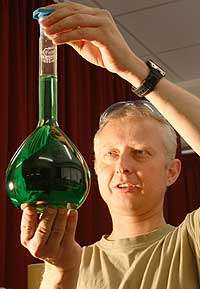
Solar cell technology developed by the University’s Nanomaterials Research Centre will enable New Zealanders to generate electricity from sunlight at a 10th of the cost of current silicon-based photo-electric solar cells.
Dr Wayne Campbell and researchers in the centre have developed a range of coloured dyes for use in dye-sensitised solar cells.
The synthetic dyes are made from simple organic compounds closely related to those found in nature. The green dye Dr Campbell (pictured) is synthetic chlorophyll derived from the light-harvesting pigment plants use for photosynthesis.
Other dyes being tested in the cells are based on haemoglobin, the compound that give blood its colour.
Dr Campbell says that unlike the silicon-based solar cells currently on the market, the 10x10cm green demonstration cells generate enough electricity to run a small fan in low-light conditions – making them ideal for cloudy climates. The dyes can also be incorporated into tinted windows that trap to generate electricity.
He says the green solar cells are more environmentally friendly than silicon-based cells as they are made from titanium dioxide – a plentiful, renewable and non-toxic white mineral obtained from New Zealand’s black sand. Titanium dioxide is already used in consumer products such as toothpaste, white paints and cosmetics.
“The refining of pure silicon, although a very abundant mineral, is energy-hungry and very expensive. And whereas silicon cells need direct sunlight to operate efficiently, these cells will work efficiently in low diffuse light conditions,” Dr Campbell says.
“The expected cost is one 10th of the price of a silicon-based solar panel, making them more attractive and accessible to home-owners.”
The Centre’s new director, Professor Ashton Partridge, says they now have the most efficient porphyrin dye in the world and aim to optimise and improve the cell construction and performance before developing the cells commercially.
“The next step is to take these dyes and incorporate them into roofing materials or wall panels. We have had many expressions of interest from New Zealand companies,” Professor Partridge says.
He says the ultimate aim of using nanotechnology to develop a better solar cell is to convert as much sunlight to electricity as possible.
“The energy that reaches earth from sunlight in one hour is more than that used by all human activities in one year”.
The solar cells are the product of more than 10 years research funded by the Foundation for Research, Science and Technology.
Source: Massey University


