Warm winter also in the Arctic
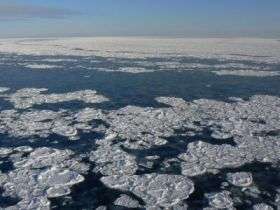
Central Europe is not the only place where the past, warm winter has caused record temperatures. Unusually mild temperatures also prevented ice formation in the Arctic, specifically in the region around Spitsbergen. This is the conclusion drawn by scientists of the Alfred Wegener Institute for Polar and Marine Research and the German Aerospace Centre (DLR).
Both institutes are members of the Helmholtz Association of German research centres. They aim to span the Helmholtz-network to observe environmental changes. Measurement activities of the recent expedition were part of the project ICESAR, and accomplished in collaboration with the European Space Agency (ESA).
Arctic sea ice plays an important role in climate change. The decline of average sea ice cover, observed over the past years, means that sea ice reflects progressively less solar energy back into space, causing temperatures in the Arctic to rise further. Usually, large areas of Spitsbergen are surrounded by ice at the end of the winter, and the fjords are frozen. “This year, our aircraft had to fly all the way to the limits of their range in order to collect sufficient data above the sea ice”, explains Dr Jörg Hartmann, climate scientist at the Alfred Wegener Institute. The recently published UN climate report highlights warming of the Arctic as one of the four key issues in relation to global climate change.
The goals of ICESAR include improvements of sea ice observations facilitated by satellite radar, as well as better predictions for weather and climate models. The research campaign provided data for the technical alignment of ESA satellite Sentinel 1, because one of its radar systems will take up observation of Arctic ice cover in 2011.
The research aircraft Polar 2, operated by the Alfred Wegener Institute, is equipped with various meteorological instruments and camera systems. During a recording flight, Polar 2 travels at low altitude while, simultaneously, another research aircraft of the DLR covers the same trajectory three kilometres higher, surveying the ice with an imaging radar system. The data collected by this method will provide the basis for a procedure using satellite images for ice data assembly.
Source: Alfred Wegener Institute for Polar and Marine Research


