2GB High-Speed Sony Memory Stick Pro
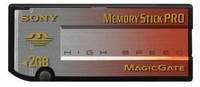
Entire Line-up Offers Reliable Performance Under Wider Temperature Range
Sony Electronics is providing Memory Stick PRO™ media users with an expanded range of enhanced media that not only offers higher capacities and are high-speed read and write capable, but are also compatible with a vast array of current Memory Stick PRO devices.
The updated Memory Stick PRO (High Speed) media features capacities of up to 2GB in the standard-size media and 1GB in the Memory Stick PRO Duo™ media size and are designed to support both read and write speeds of up to 80Mbps (10MB/s.). Among the fastest in the flash media industry, this higher speed will be especially beneficial for transferring data-intensive images, such as high-resolution digital photos, to and from PCs and other devices that may incorporate a high-speed parallel data transfer interface in the future.
"With the introduction of this faster speed Memory Stick PRO media, we are preparing for the development of new applications and devices that will demand high reading and writing speeds," said Mike Kahn, senior product manager of digital imaging accessories for Sony Electronics. "Higher quality, more data-intensive video capture might be one such application, but engineers now have the latitude to dream up even more."
______________________________________________________
What is Memory Stick?
Memory Stick was developed to realize the convenience of recording different types of digital content and sharing and exchanging them among the widest possible variety of products. It is compact, light, reliable and easy to handle. A wide variety of digital content, from photos and computer data to music and moving images, can all be stored on a single stick.
Memory Stick also offers a reliable copyright protection environment so that users can securely record copyrighted content and at the same time, the rights of copyright holders can be protected.
Versatile, compatible and user-friendly -- Memory Stick is the portable memory of choice for anyone for enjoying digital content anywhere, any time.
_______________________________________________________
"By year's end at least one-third of American households will be able to take digital photos," said Chris Chute, senior analyst with IDC. "As the trend for higher-megapixel cameras continues to increase, Sony and other manufacturers who offer large capacity, high-speed memory cards will be at the forefront of the flash memory market."
The high-performance media also offers greater reliability in extreme temperatures with an improved operating temperature range of -13°F to 185°F. Whether your Memory Stick PRO media is in your backpack on the ski slopes or in the trunk of your car on a hot summer day, you can trust your media will perform as expected. Sony will offer this expanded reliability on all Memory Stick PRO media beginning this fall.
Easily recognizable by its striking new red color and "High Speed" marking, Memory Stick PRO (High Speed) media will be available later this year as follows:
October:
-- 256MB Memory Stick PRO (High Speed) media for about $100
-- 512MB Memory Stick PRO (High Speed) media for about $170
-- 1GB Memory Stick PRO (High Speed) media for about $350
-- 256MB Memory Stick PRO Duo (High Speed) media for about $105
-- 512MB Memory Stick PRO Duo (High Speed) media for about $175
November:
-- 1GB Memory Stick PRO Duo (High Speed) media for about $350
-- 2GB Memory Stick PRO (High Speed) media for about $700
Basic Just Got Better
Sony has also upgraded its standard Memory Stick PRO media to accommodate those who want the advantages of high capacity at lower prices. The enhanced basic Memory Stick PRO media is more competitively priced and offers greater durability with the same expanded operating temperature range as the high speed. Dressed in basic black, the refreshed Memory Stick PRO media will also be available later this year as follows:
October:
-- 256MB Memory Stick PRO media for about $80
-- 512MB Memory Stick PRO media for about $150
-- 256MB Memory Stick PRO Duo media for about $85
November:
-- 512MB Memory Stick PRO Duo media for about $155
All-in-One USB Device
On top of its improved line of Memory Stick media, Sony is announcing the general availability of its versatile three-in-one USB reader/writer. The new MSAC-USM1 USB reader/writer will feature slots that accept standard-size Memory Stick® and Memory Stick PRO media, the smaller Memory Stick Duo™ and Memory Stick PRO Duo media, as well as MicroDrive and CompactFlash® (Type I/II) cards. It will accommodate the petite Memory Stick Duo and Memory Stick PRO Duo media without the use of an adaptor.
Along with the flexibility for transferring files among digital devices, the MSAC-USM1 reader/writer will also allow users to transfer content from one media card to another without first saving to a PC. The reader/writer will work with USB 2.0 and parallel interfaces to achieve high-speed data transfers when used with compatible hardware devices. The MSAC-USM1 reader/writer will be about $30.
Source: Sony


