Scientists question our understanding of the universe
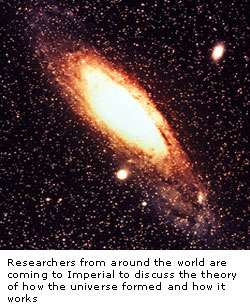
Cosmologists from around the world will meet at Imperial College London next week to challenge the theories behind the 'standard model' used to understand the universe. Speakers at the four-day conference, jointly organised by Imperial and the University of Alabama in Huntsville, and sponsored by the U.S. National Science Foundation, will cover a wide range of unanswered questions on how the universe was formed and what has been happening to it after formation.
The 'Standard Cosmological Model' is the prevailing scientific theory used to explain how the universe began with the Big Bang, how it has evolved since, and how the known atoms and molecules of everyday life, along with the postulated unknowns of the universe - dark matter and dark energy – interact with each other. Speakers at Imperial's Outstanding Questions for the Standard Cosmological Model conference will present an overview of evidence for and against this model, and will look at how to probe questions that it leaves unaddressed.
The conference will begin with key NASA observations of the cosmic microwave background, believed to be the afterglow of the Big Bang and still held as the most important piece of evidence supporting the standard model. Shaun Cole from Durham and Robert Nichol from Portsmouth will then present further supporting evidence by looking at how matter distributes across the universe in accordance with predictions of the model. This will be followed by John Cowan from Oklahoma, who will show how measurements on the age of the oldest stars led to agreement with one more prediction of the standard model – on the age of the universe.
Another important number that favours the model, namely the expansion rate of the universe (known as the Hubble constant), will be presented by Massimiliano Bonamente from Huntsville, who used Chandra satellite X-ray observations in conjunction with the technique of radio interferometry to determine this number.
In spite of the aforementioned successes, there are many scientists who feel that problems remain with the standard cosmological model. Lawrence Krauss from Case Western University and Subir Sarkar from Oxford query whether we need to postulate the existence of dark energy in the universe to explain the key observations. Tom Shanks from Durham will pose a puzzling question concerning why the instruments that measured the cosmic microwave background failed to detect shadows on this 'afterglow' radiation cast by nearby clusters of galaxies. This calls into question a key part of the standard model, which clearly predicted that such shadows should be formed, and be readily detectable.
Another vital prediction not observationally verified concerns the evolution of clusters of galaxies. While theory predicts that these systems should be rapidly evolving, the X-ray data presented by Alain Blanchard from Toulouse shows a complete absence of evolution. Additionally, Jelle Kaastra from Utrecht and Niayesh Afshordi from Harvard will demonstrate how the amount of atoms and molecules of daily life falls short of that predicted by the standard model by at least 30-40 percent.
One example of the debate at this conference is the talks of Drs Kate Land from Oxford and Carlo Contaldi from Imperial College London. After Dr Land presents her 'axis of evil', or odd alignment of structures in the cosmic microwave background, Dr Contaldi will offer a possible explanation of these alignments in terms of the process of inflation – a phase of rapid space expansion during the early universe, which is also one of the key tenets of the standard model.
Another conference speaker will be Dr Andrew Jaffe from Imperial, who will speak about the work he and his former PhD student Anastasia Niarchou have been carrying out on the topology of the universe. Topology is an extension of geometry which deals with not only shape, but the structure and nature of space which may enable us to "look in one direction and see light coming from an entirely different direction." Dr Jaffe contends that current cosmological data finally allow us to see far enough away to begin to look for these effects.
The four day event will be wrapped up by two summary speakers, Albert Stebbins from Fermilab and Richard Lieu from the University of Alabama in Huntsville, respectively the co-chair and chair of the scientific committee of this conference.
For a full programme of events, please go to: plato.tp.ph.ic.ac.uk/conferences/cosmolo gy/
Source: ICL


