Rosetta obtains 'light curve' of asteroid Steins
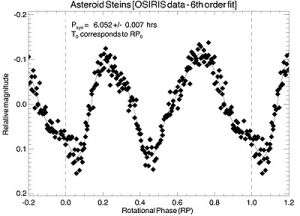
During the very first observations of Rosetta’s flyby target 2867-Steins in March 2006 the onboard camera OSIRIS obtained the most accurate ‘light curve’ of this asteroid so far.
OSIRIS observed Steins from a distance of 159 million kilometres and, from there, it obtained images and important clues about its characteristics.
Although ESA’s Rosetta is still far away from its destination comet 67P/Churyumov-Gerasimenko and its flyby targets 2867-Steins and 21-Lutetia, scientists have already started to collect preliminary data about these two largely unexplored asteroids. Advanced knowledge of the asteroids’ properties (like size and rotation period) is essential for the preparation of the planned asteroid observation campaigns in September 2008 and July 2010, respectively.
“Lutetia was imaged by Rosetta on 2 and 3 January 2007, whereas Steins was already observed during a 24-hour observation campaign on 11 March 2006. Both observations were aimed at pre-characterizing the rotation direction of the asteroid. This can be done by the study of the so-called 'light curve' of the asteroid from different locations – by analysing how the light emitted by the observed object changes intensity for different observers, one can deduce in what direction the object rotates” explains Michael Küppers from the Max-Planck-Institute for Solar System Research. The Optical, Spectroscopic, and Infrared Remote Imaging System (OSIRIS) on board Rosetta is up to this ambitious task. On its interplanetary cruise it provided an observing geometry of Steins that cannot be obtained from Earth.
Although the brightness of the Steins asteroid during the measurement period was comparable to that of a candle seen at a distance of ~2000 kilometres, OSIRIS was able to measure brightness variations of the asteroid with an accuracy of better than two percent of its total brightness.
The observations show that Steins rotates with a spin period of slightly more than six hours, in agreement with previous earth-based observations. The asymmetry of the light curve suggests an irregular shape of Steins. However, OSIRIS found no evidence for a ‘tumbling’ motion of the asteroid or the presence of a satellite. Work is ongoing to construct the orientation of the spin axis of Steins from a combination of the OSIRIS observations with ground-based data.
Basically, asteroids are elemental components of the solar system, orbiting the sun for thousand of millions of years. For scientists, these minor bodies of rock or stone are much more than only boulders. Asteroids as well as comets carry important information about the origin of the Solar System – a better understanding of which is one of the primary goals of Rosetta. Rosetta will gather valuable data as it flies by these primordial rocks.
Rosetta’s instruments will provide information on the mass and density of the asteroids, thus telling us more about their composition, and will also measure their subsurface temperature and look for gas and dust around them.
Source: ESA


