Signaling Ret-receptors protect the live of nerve cells in the aging brain
Mar 13, 2007
Signaling Ret-receptors protect the live of nerve cells in the aging brain
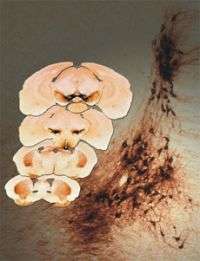
To the left several cross sections of a mouse brain are shown. In the dark labeled areas the scientists of the Max Planck Institute were able to selectively eliminate the receptor for a specific neurotrophic factor. In the background neurons that would also die due to Parkinson’s disease, but have been positively affected by GDNF and its receptor, are shown. Image: Max Planck Institute of Neurobiology

Uncontrolled neuronal death in the brain often gives rise to neurodegenerative illnesses like Parkinson or Alzheimer disease. Whether or not neurons have a long and healthy life is, apart from other factors, determined by the presence of neurotrophic factors. Scientists of the Max Planck Institute of Neurobiology have now provided unambiguous proof that the presence of the neurotrophic factor GDNF and its receptor Ret are essential for the survival of neurons in a specific brain region.

In mice the researchers inactivated the receptors of two neurotrophic factors in the substantia nigra, an area in which early cell death gives rise to Parkinson disease. The brains of these mice developed normally, however in the adult animal a significant decrease of dopaminergic neurons was observed over time, similar to what is seen in patients suffering form Parkinson disease. (PLoS Biology, March 5, 2007).

Parkinson patients suffer from loss of dopaminergic neurons in a certain region of the brain, the substantia nigra. Several experiments seem to indicate that the neurotrophic factor GDNF and its receptor might prevent an early, uncontrolled death of these neurons. The international team consisting of Edgar Kramer, Liviu Aron, Sabine Seitz und Rüdiger Klein of the Max Planck Institute of Neurobiology has now shown that neurons of the substantia nigra lacking the Ret-receptor indeed suffer an earlier death compared to normal control neurons. Loss of nerve cells and axons in this brain region is typical for Parkinson disease.

The disappearance of neurons lacking the Ret-receptor in this brain area has now for the first time been observed in mice, since the scientists were able to eliminate the receptor specifically in neurons of this brain region. The mice thus altered are viable and live as long as their normal relatives. "For the first time it was now possible to study the effects of missing GDNF signals on the establishment and maintenance of the nigrostriatal pathway (a neural pathway connecting the substantia nigra with the striatum)", stated Rüdiger Klein, Director at the Max Planck Institute of Neurobiology and head of the research team. Animals that lack GDNF and its receptor in all neurons are not viable and therefore it was not possible to investigate the precise role of GDNF and its receptor in the adult and aging brain.

"Surprisingly even without the Ret- receptor the nigrostriatal system developed normally", remarked Edgar Kramer, one of the leading scientists of the study. Only in adulthood the inability of these neurons to receive GDNF due to the missing receptor became evident and the older the animals grew, the more nerve cells died.

Worldwide more than 100 million especially older people suffer from diseases of the brain that are characterized by a gradual loss of neurons. Depending on which region of the brain is affected the symptoms vary, e.g. Alzheimer patients suffer from a progressive loss of memory whereas in Parkinson disease failures of the motor system are most evident. However, the characteristic muscle shaking and the inability to initiate movement of Parkinson’s disease, from which also prominent people like Muhammed Ali and Michael J. Fox suffer, only become apparent after more than 50 percent of the neurons have died.

"Our results will help us to understand which factors nerve cells fated to die in Parkinson’s patients need to survive" Rüdiger Klein stated. The published results are therefore of importance for promoting therapeutic approaches against Parkinson’s disease.

Citation: Edgar R. Kramer, Liviu Aron, Geert M.J. Ramakers, Sabine Seitz, Xiaoxi Zhuang, Klaus Beyer, Marten P. Schmidt & Rüdiger Klein, Absence of Ret signaling in mice causes progressive and late degeneration of the Nigrostriatal system, PLOS Biology 2007, March 5, 2007

Source: Max Planck Institute of Neurobiology

Explore further: H. pylori, smoking trends, and gastric cancer in US men

add to favorites email to friend print save as pdf

Related Stories

Sorting out structure of a Parkinson's protein

Apr 01, 2013

Clumps of proteins that accumulate in brain cells are a hallmark of neurological diseases such as dementia, Parkinson's disease and Alzheimer's disease. Over the past several years, there has been much controversy ...

Flies sleep just like us

Apr 19, 2013

(Phys.org) —Researchers at The University of Queensland have discovered that, like humans, flies sleep in stages of different intensities.

Recommended for you

H. pylori, smoking trends, and gastric cancer in US men

13 hours ago

Trends in Helicobacter pylori (H. pylori) and smoking explain a significant proportion of the decline of intestinal-type noncardia gastric adenocarcinoma (NCGA) incidence in US men between 1978 and 2008, and are estimated ...

Common food supplement fights degenerative brain disorders

18 hours ago

Widely available in pharmacies and health stores, phosphatidylserine is a natural food supplement produced from beef, oysters, and soy. Proven to improve cognition and slow memory loss, it's a popular treatment for older ...

Finding a family for a pair of orphan receptors in the brain

18 hours ago

Researchers at Emory University have identified a protein that stimulates a pair of "orphan receptors" found in the brain, solving a long-standing biological puzzle and possibly leading to future treatments for neurological ...

Insight into the dazzling impact of insulin in cells

19 hours ago

Australian scientists have charted the path of insulin action in cells in precise detail like never before. This provides a comprehensive blueprint for understanding what goes wrong in diabetes.

Do men's and women's hearts burn fuel differently?

22 hours ago

Researchers at the University of Illinois at Chicago College of Medicine will study gender differences in how the heart uses and stores fat—its main energy source—and how changes in fat metabolism play ...

Study suggests new source of kidneys for transplant

May 20, 2013

Nearly 20 percent of kidneys that are recovered from deceased donors in the U.S. are refused for transplant due to factors ranging from scarring in small blood vessels of the kidney's filtering units to the organ going too ...

User comments : 0

More news stories

Study says empathy plays a key role in moral judgments

Is it permissible to harm one to save many? Those who tend to say "yes" when faced with this classic dilemma are likely to be deficient in a specific kind of empathy, according to a report published in the scientific journal ...

If you can remember it, you can remember it wrong

(Medical Xpress)—Native peoples in regions where cameras are uncommon sometimes react with caution when their picture is taken. The fear that something must have been stolen from them to create the photo ...

B vitamins could delay dementia

(Medical Xpress)—Despite spending billions of dollars on research and development, drug companies have been unable to come up with effective treatments for dementia and Alzheimer's Disease (AD). Now, A. ...

Reducing caloric intake delays nerve cell loss

Activating an enzyme known to play a role in the anti-aging benefits of calorie restriction delays the loss of brain cells and preserves cognitive function in mice, according to a study published in the May ...

First Look: New Xbox elegant, but much unknown

Will gamers want One? After four years of development, Microsoft unveiled the Xbox One entertainment console and touted it as an all-in-one solution for playing games, watching TV and doing everything in ...

Apple case seen as possible spur to tax action

Now that tech favorite Apple Inc. has been dragged front and center into the debate over the U.S. tax code, lawmakers are hoping that the spotlight on such a high-profile company could be the catalyst for ...

Australia set to cull 10,000 wild horses

A controversial cull of up to 10,000 wild horses in Australia's harsh Outback reportedly began Wednesday in a bid to control the feral animals which officials say are destroying the land.