For Easy Tasks, Brain Preps and Decides Together
Mar 06, 2007
For Easy Tasks, Brain Preps and Decides Together
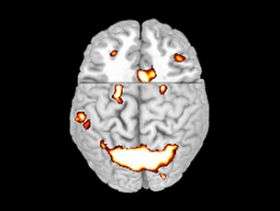
A brain scan illustrates areas that became active when the subject was presented with a stimulus. In this study, those same areas also became active when the subject was cued to the task, indicating that the same areas of the brain that respond to stimulus also contribute to preparation. Credit: Eric Schumacher/Georgia Tech

A Georgia Tech researcher has discovered that for tasks involving spatial processing, preparing for the task and performing it are not two separate brain processes, but one – at least when there are a small number of actions to choose from. The research appears online in the journal Brain Research.

In a brain imaging study using functional magnetic resonance imaging (fMRI), Eric Schumacher, assistant professor of psychology at the Georgia Institute of Technology, along with colleagues from the University of Pittsburgh and the University of California, Berkeley, monitored the activity of brain regions in subjects while they responded to visual stimuli.

The researchers predicted that when they gave the subjects a cue that they were about to perform a hard task, only the superior parietal cortex, known for its involvement in spatial attention, and the premotor cortex, known for planning movements, would activate. Then, the prefrontal cortex, known for its role in decision-making, would activate after the stimulus was presented. But they were wrong.

"We found that all of these regions began to activate when the subjects prepared to do the task, even the prefrontal, which is the region that makes the decision on what to do," said Schumacher. "Activating the decision-making region even before the stimulus is presented seems to allow for a quicker response, it allows the brain to get a running start."

Subjects were loaded into an MRI scanner and then shown a disk on a screen prompting them to press a button. They had two different tasks to perform, one labeled easy, and one hard. During the easy task, subjects were asked to push a button using the fingers of their left hand if the disk appeared on the left of the screen and their right hand if the disk appeared on the right. The hard task was manually incompatible, so that if the disk appeared on the left, they were to push the buttons using their right hand and vice-versa. Sometimes a visual cue prompted them that they were about to perform the hard or the easy task, sometimes it did not.

When the tasks were cued, all three regions of the brain increased their activity. When there was no cue, there was less activity.

So what does this mean in the real world?

"One analogous situation might be when you're driving and coming up on an intersection where there is a stale green light. You may get ready for the light to change to yellow and then red. My research suggests that this preparation for the upcoming change and appropriate responses involves the same brain regions that are involved in actually pressing the brake (or gas) once the light turns red or yellow," said Schumacher.

Source: Georgia Institute of Technology

Explore further: H. pylori, smoking trends, and gastric cancer in US men

add to favorites email to friend print save as pdf

Related Stories

Human hearing beats the Fourier uncertainty principle

Feb 04, 2013

(Phys.org)—For the first time, physicists have found that humans can discriminate a sound's frequency (related to a note's pitch) and timing (whether a note comes before or after another note) more than ...

Recommended for you

H. pylori, smoking trends, and gastric cancer in US men

5 hours ago

Trends in Helicobacter pylori (H. pylori) and smoking explain a significant proportion of the decline of intestinal-type noncardia gastric adenocarcinoma (NCGA) incidence in US men between 1978 and 2008, and are estimated ...

Common food supplement fights degenerative brain disorders

9 hours ago

Widely available in pharmacies and health stores, phosphatidylserine is a natural food supplement produced from beef, oysters, and soy. Proven to improve cognition and slow memory loss, it's a popular treatment for older ...

Finding a family for a pair of orphan receptors in the brain

10 hours ago

Researchers at Emory University have identified a protein that stimulates a pair of "orphan receptors" found in the brain, solving a long-standing biological puzzle and possibly leading to future treatments for neurological ...

Insight into the dazzling impact of insulin in cells

10 hours ago

Australian scientists have charted the path of insulin action in cells in precise detail like never before. This provides a comprehensive blueprint for understanding what goes wrong in diabetes.

Do men's and women's hearts burn fuel differently?

13 hours ago

Researchers at the University of Illinois at Chicago College of Medicine will study gender differences in how the heart uses and stores fat—its main energy source—and how changes in fat metabolism play ...

Study suggests new source of kidneys for transplant

May 20, 2013

Nearly 20 percent of kidneys that are recovered from deceased donors in the U.S. are refused for transplant due to factors ranging from scarring in small blood vessels of the kidney's filtering units to the organ going too ...

User comments : 0

More news stories

If you can remember it, you can remember it wrong

(Medical Xpress)—Native peoples in regions where cameras are uncommon sometimes react with caution when their picture is taken. The fear that something must have been stolen from them to create the photo ...

B vitamins could delay dementia

(Medical Xpress)—Despite spending billions of dollars on research and development, drug companies have been unable to come up with effective treatments for dementia and Alzheimer's Disease (AD). Now, A. ...

Reducing caloric intake delays nerve cell loss

Activating an enzyme known to play a role in the anti-aging benefits of calorie restriction delays the loss of brain cells and preserves cognitive function in mice, according to a study published in the May ...

New sleeping pill poised to hit US markets

An experimental sleeping pill from US drug company Merck is effective at helping people fall and stay asleep, according to reviewers at the US Food and Drug Administration, which could soon approve the new drug.

Changing cancer's environment to halt its spread

By studying the roles two proteins, thrombospondin-1 and prosaposin, play in discouraging cancer metastasis, a trans-Atlantic research team has identified a five-amino acid fragment of prosaposin that significantly reduces ...

New method for producing clean hydrogen

Duke University engineers have developed a novel method for producing clean hydrogen, which could prove essential to weaning society off of fossil fuels and their environmental implications.