Detecting Radiation on Lunar and Mars Missions
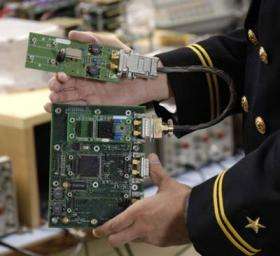
Astronauts on lunar and Mars missions will need to continually assess their radiation risk and exposure. The faculty and midshipmen at the United States Naval Academy (USNA) are developing a small device to do exactly that, as well as alert crews during high-radiation events.
“Radiation on the moon and on a three-year mission to Mars is dangerous and uncertain. Since the moon and Mars have no atmosphere and no global magnetic field, astronauts will not have the protection from radiation that we have on Earth and in low-Earth orbit,” said Dr. Vince Pisacane, a researcher on the National Space Biomedical Research Institute (NSBRI)’s Technology Development Team. “Travel away from the Earth’s surface makes it essential to monitor the types and levels of radiation exposure.”
Pisacane, along with other faculty and midshipmen of the USNA, is developing a radiation detection and assessment system, called a microdosimeter, in partnership with NSBRI. The instrument will measure radiation doses on the cellular level and help determine regulatory dose limits for scientific and medical purposes.
“In space, we can’t predict when radiation events occur nor their severity, so it’s crucial to develop a rugged, light-weight, portable system that can make real-time measurements of radiation environments,” said Pisacane, R.A. Heinlein Professor of Aerospace Engineering in USNA’s Aerospace Engineering Department.
“Spacesuits and spacecrafts integrated with microdosimeter sensors can help assess risk, provide warning at the onset of enhanced radiation so astronauts can take protective action, and help crews determine safe locations during these periods.”
Radiation negatively affects missions in a number of ways. Radiation exposure can lead to fatigue, hair loss, cataracts, vomiting, central nervous system problems, changes in physiology and genetic make up, and cancer, among other diseases. On the spacecraft, it could cause reduced power generation, background noise in sensors and the failure of electronic devices.
“Astronauts are exposed to radiations from different sources including particles trapped in the Earth’s magnetic field, cosmic rays and energetic solar events,” Pisacane said. “The instrument measures the integrated effect of a radiation field since damage depends on the types of radiation and their energy.”
Pisacane and his colleagues have developed two systems; one for ground-based lab testing and one for use in space. The microdosimeter flight instrument will be tested aboard the USNA student-built MidSTAR-1, a satellite developed by midshipmen expected to launch in early 2007 aboard a Lockheed Martin Atlas V launch vehicle. The goal of the project is to reduce the size of the sensors to the size of a deck of cards.
The flight instrument consists of three sensors and an electronic output module that collects and stores data for transmission to the ground. One sensor will be near the exterior of the spacecraft and the other two housed at different locations inside. Of the interior sensors, one resides in a block of polyethylene, which will simulate the effect of radiation on tissue.
“The sensors measure the deposition of radiation energy in tiny microscopic elements similar in size to a red blood cell,” Pisacane said.
Each of the three sensors provide an energy spectrum from the various locations within the spacecraft every three hours, but can provide more frequent updates if an enhanced-radiation event occurs. The microdosimeter will use the measurements to directly estimate the radiation risk. On the MidSTAR-1 test flight, the group will focus on testing the device’s sensitivity, resolution and response to noise.
“The microdosimeter can also be used to evaluate the effectiveness of shielding materials,” Pisacane said.
On Earth, the microdosimeter’s capabilities will be useful for nuclear material clean up, in detecting radioactive devices, and to monitor patients undergoing radiation treatment.
Source: National Space Biomedical Research Institute


