February 2, 2007 feature
Ocean Planets on the Brink of Detection
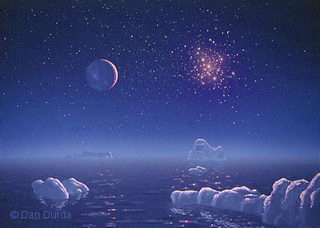
Imagine a world with no land at all, merely the impenetrable depths of a seething ocean. Models of planet formation predict the existence of such worlds, even though our own solar system has none. Indeed, their formation should actually be rather common — and new satellites may soon detect them around other stars.
Planetary embryos that form far from a star are composed mostly of water ice. Pluto and the comets are good examples of such icy bodies, as are the moons Titan and Europa. Early in our own solar system's history, the largest of these planetary embryos acquired a dense envelope of hydrogen and helium and transformed into the gas giants we know today. But what would happen if they drifted a bit closer to the Sun before getting so big?
Planets that form far from their parent star are expected to have a composition similar to comets (50% rock, 50% water by weight). Once a planet exceeds about ten Earth masses it has enough gravity to attract any hydrogen and helium near its orbit, and will rapidly transform into a gas giant. But what happens to planets in this region that never exceed the threshold?
It becomes an "ocean planet", a term coined by Alain Léger (Université Paris-Sud, France) when he first proposed the existence of such worlds in 2003. An ocean planet that stays in the outer disk will probably be captured by the gas giants forming there, perhaps to become a moon like Europa. Such worlds will be composed mostly of rock and ice, and depending on their environment and formation history may harbor liquid oceans below their surface.
Hydrodynamic simulations have shown that it is common for planets to migrate inwards or outwards as they plunge through the turbulent gas of the disk. It is therefore quite possible for an ocean planet to creep close enough to its star to melt the ice.
So why doesn't our system have any ocean planets? It's hard to say, but it's also clear that random chance plays a large role in planet formation. "Simulations ... starting from random initial conditions produce a broad diversity of planets, including small planets migrating through the ice line." explains Franck Selsis (Ecole Normale Supérieure de Lyon, France), one of Léger’s principle collaborators and the author of a more recent article on the detection of ocean planets. "Planets with masses less than 20 Earth-masses have been found at short periods with the instrument HARPS."
These objects are too big to be ocean planets; rather, they are small gas giants like Neptune or Uranus. As gas giants cannot form close to a star, it appears that they must have formed in the outer planetary nebula and migrated inwards. As Selsis tells PhysOrg.com, "Their detection shows that the process that can give birth to ocean planets is common."
Water, water every where...
The water content of the Earth is only about one part in 4400, yet water covers over two-thirds of its surface. Not only would water cover the entire surface of an ocean planet, but its average depth would on the order of 100 kilometers!
All the rocky matter would sink to the center of the planet, forming a dense core not unlike the Earth's. Where the Earth has a thick mantle of magma, however, ocean planets would have a mantle of exotic ice. The pressure at the bottom of the ocean would be10 million atmospheres or more; under such a crushing weight, water has no choice but to solidify.
...nor any drop to drink.
Depending on its proximity to the star, an ocean planet's surface might be icy, liquid, or some combination of the two. If it gets too close, however, the surface temperature might rise high enough for the oceans to transform into a global sauna. Such a planet wouldn’t have an ocean at all; at temperatures above the critical point of water, the distinction between liquid and gas disappears. Instead of an ocean, the ice mantle would be surrounded by a thick envelope of supercritical water: an even mix of vapor and suspended droplets at hundreds of degrees Celsius.
Right now, ocean planets exist only in the realm of theory. They might well be detected by the recently launched CoRoT satellite, however. In a recent article posted to arXiv.org, Selsis describes how CoRoT and ground-based observations can be combined to estimate the density of extrasolar planets and thus tell the difference between an ocean world and a rocky world like the Earth. In the case of CoRoT any ocean worlds it can detect will be much closer to their star than even Mercury is to the Sun. The Kepler satellite (due to launch in 2008), on the other hand, will be able to detect such planets as far out as the habitable zone of some stars.
Planet-finders have much to look forward to, and the discovery of these exotic worlds will provide a great deal of support for current theories of planet formation. Nobody knows yet whether such planets could evolve life, but they clearly have one of the essential ingredients in abundance.
Citations:
1. Alain Léger et al. 2004, "A new family of planets? 'Ocean Planets' ". Icarus 169, 499L. An online version of this paper is available at arxiv.org/abs/astro-ph/0308324.
2. Franck Selsis et al. 2007, "Could we identify hot ocean planets with CoRoT, Kepler, and Doppler velocimetry?" Icarus (submitted); an online version of this paper is available at xxx.arxiv.org/abs/astro-ph/0701608 .
By Ben Mathiesen, Copyright 2007 PhysOrg.com.
All rights reserved. This material may not be published, broadcast, rewritten or redistributed in whole or part without the express written permission of PhysOrg.com.


