Physicists manipulate temperature of Kondo effect

Jan 31, 2007

Physicists at Ohio University have learned how to manipulate the temperature of the Kondo effect, which they observed for the first time in a two-dimensional molecular layer.

In a recent issue of the journal Physical Review Letters, the scientists reported that they were able to manipulate and tune the Kondo effect by removing one molecule at a time from a small molecular assembly.
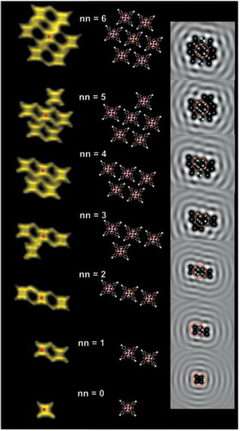
Physicists manipulate temperature of Kondo effect
The researchers created a hexagonal unit of molecules by manipulating the nearest neighbor molecules. Credit: Saw-Wai Hla

The most important and useful property of molecules in nanotechnology is their ability to self-assemble and form molecular layers, said lead author Saw-Wai Hla, an associate professor of physics and astronomy at Ohio University. Many molecules, each having specific properties useful for nanodevices, can spontaneously assemble on substrates.

“This process is critical for the ‘bottom up’ approach in nanotechnology,” Hla said. “The manipulation of the Kondo effect inside the molecular layer is significant and may have an impact on the development of nanoscale molecular memory devices and for quantum computation.”

In the recent experiment, porphyrin molecules with a magnetic cobalt atom caged at each molecule’s center were self-assembled on a copper crystal surface. The researchers used a custom built low-temperature scanning tunneling microscope to create a hexagonal unit of molecules by manipulating the nearest neighbor molecules.

The scanning tunneling microscope tip was used to detect the Kondo effect above the center molecule at — 450 F. The scientists found that reducing the number of molecules surrounding the hexagonal unit increased the Kondo temperature. When the center molecule is surrounded by six molecules, it has little chance to interact with outside electrons.

When the neighboring molecules are removed one at a time, however, the center unit can interact with surrounding free electrons from the copper surface. This changes the Kondo temperature, which is an indicator of how strong the magnetic atom inside the molecule is interacting with the free electrons.

“We are currently storing data at the level of millions, but if molecular memory devices could be developed using this phenomenon, then we could be storing data at the level of billions in the future,” Hla said.

Source: Ohio University

Explore further: As chaos celebrates its 50th birthday, biophysicist develops a new method to visualize it

add to favorites email to friend print save as pdf

Related Stories

Keeping time: Circadian clocks

Oct 02, 2012

Our planet was revolving on its axis, turning night into day every 24 hours, for 4.5 billion years - long before any form of life existed here. About a billion years later, the very first simple bacterial ...

Kondo effect in single magnetic molecules

Jun 07, 2006

The Kondo effect was first explained more than 40 years ago by a Japanese physicist. It opened a new chapter in the study of fundamental physics. Now, that door is being pushed open a little further, thanks to the efforts ...

Targeted virus compels cancer cells to eat themselves

May 02, 2006

An engineered virus tracks down and infects the most common and deadly form of brain cancer and then kills tumor cells by forcing them to devour themselves, researchers at The University of Texas M. D. Anderson Cancer Center ...

Recommended for you

Engineers pioneer flat spray-on optical lens

7 hours ago

A University of British Columbia engineer and a team of U.S. researchers have made a breakthrough utilizing spray-on technology that could revolutionize the way optical lenses are made and used.

How do cold ions slide

9 hours ago

Things not always run smoothly. It may happen, actually, that when an object slides on another, the advancement may occur through a 'stop and go' series in the characteristic manner which scientists call ...

User comments : 0

More news stories

A quantum simulator for magnetic materials

Physicists understand perfectly well why a fridge magnet sticks to certain metallic surfaces. But there are more exotic forms of magnetism whose properties remain unclear, despite decades of intense research. ...

Engineers pioneer flat spray-on optical lens

A University of British Columbia engineer and a team of U.S. researchers have made a breakthrough utilizing spray-on technology that could revolutionize the way optical lenses are made and used.

Researchers forward quest for quantum computing

Research teams from UW-Milwaukee and the University of York investigating the properties of ultra-thin films of new materials are helping bring quantum computing one step closer to reality.

How do cold ions slide

Things not always run smoothly. It may happen, actually, that when an object slides on another, the advancement may occur through a 'stop and go' series in the characteristic manner which scientists call ...

Controlling mood through the motions of mitochondria

(Medical Xpress)—Regulating the distribution of power in neurons is done by a system that makes the national electric grid look simple by comparison. Each neuron has several thousand mitochondria confined ...

Google Drive sports new view and scan enhancements

(Phys.org) —Google Drive has a new look and functions. The makeover in Google Drive features scanning and interface enhancements that put the user into "card" mode. The enhancements make it easy for the ...