Improved Nanodots Could Be Key to Future Data Storage
Jan 19, 2007
Improved nanodots could be key to future data storage
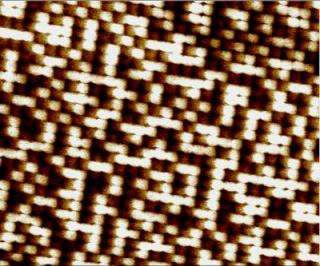
False-color image of 50-nanometer cobalt-palladium nanodots made with a magnetic force microscope provides both topographic and magnetic profiles. The darker dots are magnetized in the up direction (representing 1 in binary code) and the lighter dots are pointing down (representing 0). Credit: NIST

The massive global challenge of storing digital data--storage needs reportedly double every year--may be met with a tiny yet powerful solution: magnetic particles just a few billionths of a meter across. This idea is looking better than ever now that researchers at the National Institute of Standards and Technology (NIST) and collaborators have made nanodot arrays that respond to magnetic fields with record levels of uniformity.

The work enhances prospects for commercially viable nanodot drives with at least 100 times the capacity of today's hard disk drives.

A nanodot has north and south poles like a tiny bar magnet and switches back and forth (or between 0 and 1) in response to a strong magnetic field. Generally, the smaller the dot, the stronger the field required to induce the switch. Until now researchers have been unable to understand and control a wide variation in nanodot switching response. As described in a new paper,* the NIST team significantly reduced the variation to less than 5 percent of the average switching field and also identified what is believed to be the key cause of variability--the design of the multilayer films that serve as the starting material for the nanodots.

Nanodots, as small as 50 nanometers (nm) wide, were fabricated using electron beam lithography to pattern multilayer thin films. The key was to first lay down a tantalum "seed layer" just a few nanometers thick when making a multilayer film of alternating layers of cobalt and palladium on a silicon wafer. The seed layer can alter the strain, orientation or texture of the film. By making and comparing different types of multilayer stacks, the researchers were able to isolate the effects of different seed layers on switching behavior. They also were able to eliminate factors previously suspected to be critical, such as lithographic variations, nanodot shape or crystal grain boundaries.

Nanodots are one of two major approaches being pursued around the world as possible means of boosting the density of magnetic data storage. The other involves using a laser to heat and switch individual bits. The ultimate solution may be a combination of the two approaches, because heat reduces the strength of the magnetic field needed to switch nanodots, according to Justin Shaw, lead author of the new paper. Considerable work still needs to be done to make this type of patterned media commercially viable: Dot dimensions need to be reduced to below 10 nm; techniques to affordably fabricate quadrillions of dots per disk need to be developed; and new methods to track, read, and write these nanoscale bits need to be devised. The NIST authors collaborated with scientists at the University of Arizona, where some of the nanodot samples were made.

Citation: J.M. Shaw, W.H. Rippard, S.E. Russek, T. Reith and C.M. Falco. 2007. Origins of switching field distributions in perpendicular magnetic nanodot arrays. Journal of Applied Physics. 101, 023909 (2007), Jan. 15.

Source: National Institute of Standards and Technology

Explore further: Physicists develop revolutionary low-power polariton laser

add to favorites email to friend print save as pdf

Related Stories

Physicists discover 'magnetotoroidic effect'

Sep 26, 2011

(PhysOrg.com) -- For many years, scientists have known about the magnetoelectric effect, in which an electric field can induce and control a magnetic field, and vice versa. In this effect, the electric field has always been ...

Researchers use nanodots to boost superconductivity

Apr 04, 2006

Oak Ridge National Laboratory researchers have demonstrated a way to sustain high supercurrents in wires in the presence of a large applied magnetic field -- a step which could greatly expand practical applications of superconductors. ...

Nano World: Superconducting wires

Apr 01, 2006

Nanotechnology could help enable the next generation of superconducting wires for everything from new city power grids to levitating trains, experts told UPI's Nano World.

Recommended for you

Breakthrough calls time on bootleg booze

May 20, 2013

(Phys.org) —Using a laser, the St Andrews scientists can now carry out detailed analysis of a spirit sample no bigger than a teardrop and can even confirm whether it is toxic or not. It's hoped the testing ...

Bringing life into focus

May 17, 2013

Spinning-disk confocal microscopy is an optical imaging technique that can be used to generate detailed three-dimensional fluorescence images of living cells and their contents. Although a powerful tool for ...

User comments : 0

More news stories

How gold nanoparticles can help fight ovarian cancer

Positively charged gold nanoparticles are usually toxic to cells, but cancer cells somehow manage to avoid nanoparticle toxicity. Mayo Clinic researchers found out why, and determined how to make the nanoparticles effective ...

Radioactive nanoparticles target cancer cells

Cancers of all types become most deadly when they metastasize and spread tumors throughout the body. Once cancer has reached this stage, it becomes very difficult for doctors to locate and treat the numerous tumors that can ...

First Look: New Xbox elegant, but much unknown

Will gamers want One? After four years of development, Microsoft unveiled the Xbox One entertainment console and touted it as an all-in-one solution for playing games, watching TV and doing everything in ...

Study says empathy plays a key role in moral judgments

Is it permissible to harm one to save many? Those who tend to say "yes" when faced with this classic dilemma are likely to be deficient in a specific kind of empathy, according to a report published in the scientific journal ...

Apple case seen as possible spur to tax action

Now that tech favorite Apple Inc. has been dragged front and center into the debate over the U.S. tax code, lawmakers are hoping that the spotlight on such a high-profile company could be the catalyst for ...

Australia set to cull 10,000 wild horses

A controversial cull of up to 10,000 wild horses in Australia's harsh Outback reportedly began Wednesday in a bid to control the feral animals which officials say are destroying the land.