Walking molecule now carries packages
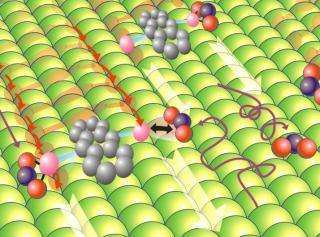
A research team, led by UC Riverside's Ludwig Bartels, was the first to design a molecule that can move in a straight line on a flat surface. Now this team has found a way to attach cargo: two CO2 molecules, making the nano-walker a molecule carrier.
The work will be published Thursday, Jan. 18 in Science Express and later in the print-version of the journal Science.
"This is an unprecedented step forward towards the realization of molecular-scale machinery," said Bartels, associate professor of chemistry and a member of UCR's Center for Nanoscale Science and Engineering. "Our experiments show a means to transport molecules reliably. This will become as important to the molecular machinery of the future as trucks and conveyor belts are for factories of today."
The last paper Bartels and his team published on this subject generated a great deal of interest. It was included in the American Institute of Physics "Top 25 Physics Stories for 2005." The new molecule carrier runs on a copper surface. It can pick up and release up to two carbon dioxide (CO2) molecules and carry them along its straight path.
"Carrying a load slows the molecule down" explained Bartels. "Attachment of one CO2 molecule makes the carrier need twice as much energy for a step, and a carrier with two CO2s requires roughly three times the energy. This is not unlike a human being carrying heavy loads in one or both hands." Bartels explained that using machines at the scale of single molecules will ultimate be the most efficient way to build objects or to deliver material.
"It resembles the way nature does it: the molecule carrier transports carbon dioxide across a surface," he said. "In the human body, the molecule hemoglobin carries oxygen from and carbon dioxide to the lungs, thereby allowing us to breathe – and to live."
Bartels cautions, however, that this research is still in its infancy. "In 2005 we invented the molecular walker, which moves in a straight line rather than hopping around in all directions as a normal molecule would do. Now it can carry a load."
Bartels said the continuing evolutionary process will take some time.
"Ten years ago, a cell phone could just place calls, nothing else. Now it plays mp3-files, organizes your day, lets you send emails and browse the web." He said his team will be pursuing the next step for this molecule carrier. "Next, we would like to be able to make one go around corners, rotate its cargo or send out photons to tell us where it is."
The molecule carrier is anthraquinone, which consists of three fused benzene rings with one oxygen atom on each side. An organic compound, anthraquinone is widely used in the pulp industry for turning cellulose from wood into paper. It is also the parent substance of a large class of dyes and pigments. Its chemical formula is C14H8O2.
The UCR study used a scanning tunneling microscope in Bartels's laboratory that gives a precise picture of individual molecules. Experiments took place on a highly polished copper surface, cleaned so that only the desired molecules were present on it. An individual anthraquinone molecule appears in Bartels' microscope as an almost rectangular feature with slightly rounded edges.
Source: University of California - Riverside


