Study: Temperate Forests Could Worsen Global Warming
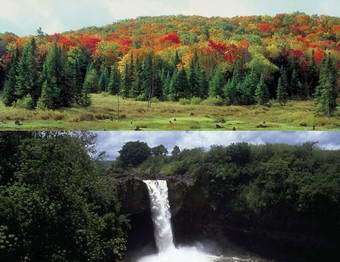
Growing a forest might sound like a good idea to combat global warming, since trees draw carbon dioxide from the air and release cool water from their leaves. But they also absorb sunlight, warming the air in the process. According to a new study from the Carnegie Institution’s Department of Global Ecology and Lawrence Livermore National Laboratory, planting forests at certain latitudes could make the Earth warmer.
Image: New climate modeling research from the Carnegie Institution and Lawrence Livermore National Laboratory shows that northern temperate forests (top) may contribute to global warming, while tropical forests (bottom) can help keep global temperatures cool.
Carnegie’s Ken Caldeira will present the work at the American Geophysical Union Fall Meeting in San Francisco on December 7, 2005.
The researchers used complex climate modeling software to simulate changes in forest cover and then examined the effects on global climate. Their results were surprising. “We were hoping to find that growing forests in the United States would help slow global warming,” Caldeira said. “But if we are not careful, growing forests could make global warming even worse.”
The researchers found that while tropical forests help keep Earth cool by evaporating a great deal of water, northern forests tend to warm the Earth because they absorb a lot of sunlight without losing much moisture. In one simulation, the researchers covered much of the northern hemisphere (above 20° latitude) with forests and saw a jump in surface air temperature of more than 6° F. Covering the entire planet’s land mass with trees led to a more modest increase of about 2° F.
When the scientists restricted the simulation to middle latitudes such as the continental United States, the picture was not quite so clear. At first, cooling due to the uptake of carbon dioxide would offset warming from sunlight absorption. But after several decades, carbon dioxide would begin diffusing from the ocean into the atmosphere, diminishing the cooling effect and warming the Earth in the long term.
Caldeira warns against planting forests on abandoned croplands as a strategy to combat global warming, which some have recommended. But he also recognizes the importance of forests.
“I like forests. They provide good habitats for plants and animals, and tropical forests are good for climate, so we should be particularly careful to preserve them,” Caldeira commented. “But in terms of climate change, we should focus our efforts on things that can really make a difference, like improving efficiency and developing new sources of clean energy.”
The study, authored by Seran Gibbard, Ken Caldeira, Govindasamy Bala, Thomas J. Phillips, and Michael Wickett, will be published online under the title “Climate effects of global land cover change” in the journal Geophysical Research Letters on December 8, 2005.
Source: Carnegie Institution of Washington
-
From lemons to lemonade: Reaction uses carbon dioxide to make carbon-based semiconductor,
32 comments
-
Thioridazine kills cancer stem cells in human while avoiding toxic side-effects of conventional cancer treatments,
3 comments
-
SpaceX private rocket blasts off for space station (Update),
42 comments
-
Climate scientists say they have solved riddle of rising sea,
31 comments
-
SpaceX capsule has 'new car' smell, astronauts say (Update),
4 comments
Ancient tree-ring records from southwest U.S. suggest today's megafires are truly unusual
More news stories
Change in developmental timing was crucial in the evolutionary shift from dinosaurs to birds: study
At first glance, it's hard to see how a common house sparrow and a Tyrannosaurus Rex might have anything in common. After all, one is a bird that weighs less than an ounce, and the other is a dinosaur that ...
Other Sciences / Archaeology & Fossils
10 hours ago |
5 / 5 (8) |
0
|
Social welfare cuts ultimately come with heavy price, researchers say
(Phys.org) -- Slashing government funding for Medicaid, food stamps and other programs that serve the poor while politically popular with some lawmakers and many conservatives may do more harm ...
Other Sciences / Social Sciences
May 24, 2012 |
4.1 / 5 (22) |
156
Ancient Bethlehem seal unearthed in Jerusalem
Israeli archaeologists have discovered a 2,700-year-old seal that bears the inscription "Bethlehem," the Israel Antiquities Authority announced Wednesday, in what experts believe to be the oldest artifact ...
Other Sciences / Archaeology & Fossils
May 23, 2012 |
3.3 / 5 (15) |
24
Dollars and sense: Why are some people morally against tax?
As the U.S. presidential election campaigns heat up, the economic debate is dominated by bailouts, austerity and, inevitably, taxation. Now a new study published in Symbolic Interaction asks why tax is such an important issue ...
Other Sciences / Social Sciences
May 23, 2012 |
2.3 / 5 (3) |
20
Oldest Jewish archaeological evidence on the Iberian Peninsula
German archaeologists of the Friedrich Schiller University Jena found one of the oldest archaeological evidence so far of Jewish Culture on the Iberian Peninsula at an excavation site in the south of Portugal, ...
Other Sciences / Archaeology & Fossils
May 25, 2012 |
4.2 / 5 (6) |
12
'Unzipped' carbon nanotubes could help energize fuel cells, batteries
Multi-walled carbon nanotubes riddled with defects and impurities on the outside could replace some of the expensive platinum catalysts used in fuel cells and metal-air batteries, according to scientists at ...
Computer model used to pinpoint prime materials for efficient carbon capture
When power plants begin capturing their carbon emissions to reduce greenhouse gases and to most in the electric power industry, it's a question of when, not if it will be an expensive undertaking.
T cells 'hunt' parasites like animal predators seek prey, study shows
By pairing an intimate knowledge of immune-system function with a deep understanding of statistical physics, a cross-disciplinary team at the University of Pennsylvania has arrived at a surprising finding: T cells use a movement ...
Stunning image of smallest possible five-ringed structure
Scientists have created and imaged the smallest possible five-ringed structure about 100,000 times thinner than a human hair and you'll probably recognise its shape.
Land and sea species differ in climate change response: study
(Phys.org) -- Marine and terrestrial species will likely differ in their responses to climate warming, new research by Simon Fraser University and Australia’s University of Tasmania has found.
Yale study concludes public apathy over climate change unrelated to science literacy
Are members of the public divided about climate change because they don't understand the science behind it? If Americans knew more basic science and were more proficient in technical reasoning, would public consensus match ...