New Comet Discovered from Mauna Kea
Dec 05, 2005
New Comet Discovered from Mauna Kea

While searching for "killer asteroids" on Halloween night, University of Hawaii astronomer Fabrizio Bernardi found a new comet, the first discovered from Mauna Kea Observatories.

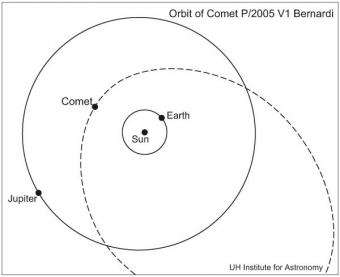
Image: Orbit of Comet P/2005 V1 Bernardi

"While studying images I had taken with the Canada-France-Hawaii Telescope, I noticed an object with a faint tail. I checked to see if there were any known comets in that part of the sky, and was surprised to find that there were none," said Bernardi.

"I consulted with my colleagues David Tholen, Andrea Boattini, and Jana Pittichová, and we decided to monitor the object for a few nights. Having confirmed that it was a comet, we reported the find to the International Astronomical Union."

The comet is now officially "P/2005 V1 Bernardi" after its discoverer.

The comet, which orbits the Sun about once every 10 years, does not come close enough to Earth to be visible to the naked eye. When discovered, it was about 280 million miles away from Earth—almost three times the distance from Earth to the Sun. The length of its tail is estimated to be more than 13,000 miles.

Bernardi is working with Tholen, a UH astronomer who heads a NASA-funded program to find asteroids that pass close to Earth and are therefore potentially dangerous.

Source: University of Hawaii

Explore further: Communications satellite launched into space

add to favorites email to friend print save as pdf

Related Stories

400-Meter Asteroid May Hit Earth on 13 April, 2029

Dec 24, 2004

A recently rediscovered 400-meter Near-Earth Asteroid (NEA) is predicted to pass near the Earth on 13 April 2029. The flyby distance is uncertain and an Earth impact cannot yet be ruled out. The odds of impact, ...

Recommended for you

Galaxies fed by funnels of fuel

May 24, 2013

(Phys.org) —Computer simulations of galaxies growing over billions of years have revealed a likely scenario for how they feed: a cosmic version of swirly straws.

Dark, massive asteroid to fly by Earth on May 31

May 24, 2013

It's 1.7 miles long. Its surface is covered in a sticky black substance similar to the gunk at the bottom of a barbecue. If it impacted Earth it would probably result in global extinction. Good thing it is ...

Source of life running out: water scientists

May 24, 2013

The majority of people on Earth people will face severe water shortages within a generation or two if pollution and waste continues unabated, scientists warned at a conference in Bonn Friday.

Research team explains 'Lazarus' comets

May 24, 2013

Astronomers from the University of Antioquia have discovered a graveyard of comets. These once-dormant comets, dubbed by astronomers as "The Lazarus comets," are now rejuvenated.

User comments : 0

More news stories

Galaxies fed by funnels of fuel

(Phys.org) —Computer simulations of galaxies growing over billions of years have revealed a likely scenario for how they feed: a cosmic version of swirly straws.

Century-old science helps confirm global warming

(Phys.org) —Ocean measurements taken more than 135 years ago during the scientific expedition of HMS Challenger have provided further confirmation of human-produced global warming over the past century.