Crystal of holes discovered: Unusual state of matter
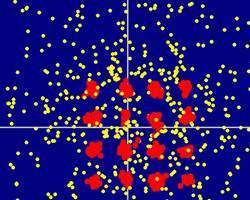
The existence of an unusual state of matter, a crystal that consists entirely of holes, has been proven at Kiel University (Germany). As reported in the latest issue of Physical Review Letters (December 2nd , 2005), an international team led by Professor Michael Bonitz has, for the first time, demonstrated with the help of extensive computer simulations that this exotic phenomenon, the existence of which was hitherto only a subject of speculation, should certainly occur. The physicists have also been able to predict the conditions for its formation.
Image: Holes in the theory. Even though a hole (red) is merely the absence of an electron (yellow) in a material, holes can crystallize under the right conditions, according to computer simulations. (M. Bonitz/Christian Albrechts Univ.)
"We now know that this effect occurs in semiconductors with a certain type of band structure", says Bonitz. "In normal solids, the electrons and holes (which are formed when electrons are excited) are both far extended inside the solid - a consequence of quantum mechanics. Electrons and holes penetrate the material like a liquid". However, when the mass of a hole exceeds a certain critical value - 80 times the mass of an electron - the hole liquid undergoes a spontaneous change to become a crystal. Furthermore, there are strong indications that in semiconductor systems of this kind, a reduction of pressure can result in the formation of Bose condensates of bound electron-hole pairs (so-called excitons). Anticipating the next stage of the research, the physicist explains that "the next exciting problem is to set up an experiment that will confirm our prediction of the crystal of holes". Suitable materials systems for this have already been suggested.
The scientist at the Institute of Theoretical Physics and Astrophysics explains that the crystal of holes is also of great interest for another reason: "We have been able to show that it has many features in common with very different kinds of crystals, such as plasma crystals or ionic crystals". It is especially intriguing that the crystal of holes shows many similarities with some of the most mysterious objects in the universe - white dwarfs and neutron stars. It has been suggested that a crystal of nuclei exists in these exotic, very distant objects. Bonitz hopes that "it may soon be possible to study important properties of these systems in the laboratory by experiments on a crystal of holes".
This extraordinary kind of crystal may also be of interest for materials research, says Bonitz, "because it may possess properties of importance for superconductivity". Whereas superconductivity (a flow of electrical current with no resistance) can only be achieved at present at very low temperatures, some scientists, in particular the 2003 Physics Nobel Prize winner Alexei Abrikosov, expect that systems containing a crystal of holes should become superconducting at significantly higher temperatures. This presents the Kiel scientists and their partners with a challenge, and Bonitz comments that "an important aim of our continuing investigations will be to test these predictions".
In his research, Professor Michael Bonitz is collaborating with a German-Russian team of scientists, which includes Professor Holger Fehske (Greifswald University) and Dr. Vladimir S. Filinov (Institute for High Energy Density, Moscow). The project forms a part of the Transregional Collaborative Research Centre TR 24, on "Fundamentals of Complex Plasmas", which was recently approved by the Deutsche Forschungsgemeinschaft (German Research Foundation), and is based at the universities of Greifswald and Kiel.
The research results haven been selected by the American Physics Society for coverage in its online journal Physical Review Focus, see focus.aps.org/story/v16/st17
Source: Christian-Albrechts-Universitaet zu Kiel


