December 18, 2006 feature
Physics Reveals the Key to a Great Golf Swing
What happens when a golf-loving researcher injures a shoulder and can't play for three months? Rod White, a metrologist (measurement scientist), used the spare time off the course to undertake an analysis that revealed the foundation of an effective golf swing. As it turns out, it's all in the wrists.
“Even the most able golfers experience occasions when a ball hit deliberately with little effort inexplicably travels further than expected,” said White, of technology company Industrial Research Ltd. in Lower Hutt, New Zealand, to PhysOrg.com. “But there is an explanation. A double pendulum model, which represents the golf swing reduced to its simplest elements, explains this effect and how to make a swing more efficient.”
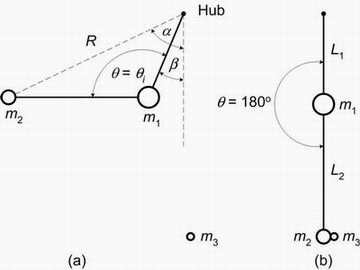
A double pendulum consists of one pendulum tacked on to the end of another. The upper pendulum swings from a fixed pivot point and the lower pendulum swings from the end of the upper one. In golf, the equivalent components are the shoulders (acting as the fixed pivot), arms and hands (the upper pendulum), and the club shaft and club head (the lower pendulum).
There are several factors influencing the efficiency of a golf swing. Among them are the length of the club, the length of the player's arms, the mass of the club head, the wrist-cock angle – how far backward the wrists are bent during the swing – and whether the wrists actively twist during the swing, resulting in wrist torque.
White's analysis is the first to consider wrist-cock angle. His model is also very simple in a Physics 101 kind of way, explaining the mechanics of the golf swing in terms of the club's changing moment of inertia. These two points distinguish his work from similar analyses by C.B. Daish1 and the late University of Nebraska physicist Theodore Jorgensen2.
White shows that the energy and momentum of the arm-club system are redistributed during the swing as a direct result of the uncocking of the wrists that takes place before the club strikes the ball.
“As the wrists uncock near the bottom of the swing, the club head and the hands are moving in different directions, which means the club pulls against the hands and slows them down,” White said. “This means, in turn, that the kinetic energy in the shoulders and arms is transferred to the club. Without wrist-cock, most of the kinetic energy stays in the arms and shoulders and the swing is inefficient. Best of all, the golfer does not have to do any extra work to make the transfer happen.” Thus, wrist-cock is the make-or-break factor in a good golf swing.
The full range of motion of the double pendulum is described by two complicated equations. In fact, White says, they are too complicated to be of much help in a study of the golf swing. “They obscure the basic mechanism by which the golf swing derives its efficiency.”
He simplified the equations by removing the components that account for radial motion – motion away from the shoulders, such as what would happen if the club handle slipped down slightly in the golfer's hands during the swing. There are two key points in the swing where radial motion does not factor in: at the end the first half of the swing when the golfer is holding the club at a fixed wrist-cock angle and about to release the club, and the instant before the club head strikes the ball, when the golfer's arms and the club line up vertically. By using these two snapshots, White broke the swing down into a much more basic and manageable system.
“This model helps explain why learning a good swing can be difficult,” he concludes. “Both the extraordinary effectiveness of wrist cock in gaining distance (without having to do additional work) and the loss in distance that occurs with the application of wrist torque are counter-intuitive.”
Citation: Rod White, “On the efficiency of the golf swing,” Am. J. Phys., 74 1088-1094 (2006)
References:
1 C.B. Daish, The Physics of Ball Games. (London: The English University Press, 1972)
2 Theodore P. Jorgensen, The Physics of Golf. (Melville, NY: The American Institute of Physics, 1994)
By Laura Mgrdichian, Copyright 2006 PhysOrg.com


