Neutrons, the Spies of the Nanoworld
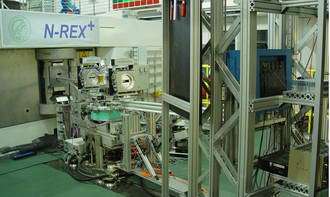
A new kind of neutron/X-ray reflectometer called "N-REX +" has been inaugurated by the Max Planck Institute for Metals Research in Stuttgart and the Technical University of Munich today at the research neutron source Heinz Maier-Leibnitz in Garching, Germany. N-REX+ (Neutron Reflectometry & X-Rays) is one of two neutron spectrometers that are unique worldwide; the other one is TRISP (Triple Axis Resonance Spin echo Spectrometer), already in service at the research neutron source.
Image: The new neutron spectrometer N-REX+ (Neutron Reflectometry & X-Rays) at the research neutron source Heinz Maier-Leibniz in Garching, Germany. (Max Planck Institute for Metals Research)
Both were designed and built at the high flux neutron source by Max Planck researchers over the past five years. They cost several millions of euros. From these high-tech measurement devices, scientists expect to gather new findings about nanomaterials -- particularly concerning the microscopic mechanisms behind high temperature superconductivity and the atomic processes at the inner interfaces of artificial multilayers and thin films. Both neutron spectrometers constitute the centre of work in the inter-institutional research initiative "Material and Solid State Research with Neutrons".
New technologies require scientists to develop brand-new materials, and also understand their characteristics and functions at microscopic and nanoscopic levels. Material structures are becoming increasingly small and complex, all the way to atomic dimensions. This is true for materials and material combinations of all different classes --from metals, semiconductors, and ceramics, to organic and biological materials. In order to manipulate the operations of these kind of complex systems, the scientists first need detailed knowledge of their chemical, electronic, and magnetic structures. Neutrons play a key role in this, as the "spies of the nanoworld".
For a year now, the high flux source at Garching has been creating the particularly stealthy neutrons. They are able to move through materials without a trace and without destroying the material systems under investigation. They provide a detailed microscopic picture of the atomic inner life of the material they have passed through. Neutrons are ideal for describing, in particular, magnetic nanostructures and radiation-sensitive organic and biological materials, all the way to their atomic structures.
The neutron spectrometers N-REX+ and TRISP investigate complex solid-state structures and functional thin film systems using a new kind of analysis. It involves the neutron's spin, whose rotational speed can be precisely set using an external magnetic field. Professor Helmut Dosch, the co-ordinator of the research project, explains that "each neutron is sent on a trip through the nanoworld at its own spin, which gives it its own individual clock. At the end of the trip, when the neutron is detected, the clock can be read. Then, the smallest deviations and speed changes in the neutrons provide evidence for the structure and characteristics of the material being investigated."
A number of Max Planck Institutes have been working together in the new research initiative in order to find efficient solutions to the difficult measurement problems. The two spectrometers have been installed by the Max Planck Institute for Metals Research and for Solid State Research. The first major experiments in Garching are to be carried out over the next five years by the Max Planck Institute for Polymer Research in Mainz, of Colloids and Interfaces in Golm, of Plasma Physics in Garching, for Chemical Physics of Solids in Dresden, and for Iron Research in Duesseldorf.
Related links:
[1] The research neutron source FRM-II in Garching, Germany
[2] Materials Science with X-rays and Neutrons at FRM-II: The X-ray/neutron reflectometer N-REX+
Source: Max Planck Institute for Solid State Research


