Why do some queen bees eat their worker bee's eggs?
Dec 04, 2006
Why do some queen bees eat their worker bee's eggs?
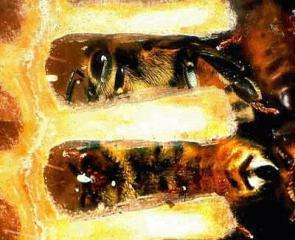
A new study from the American Naturalist finds that honeybee workers’ sons are reared 100 times less in species with a queen mated to multiple males. Credit: Courtesy F. Ratnieks

Worker bees, wasps, and ants are often considered neuter. But in many species they are females with ovaries, who although unable to mate, can lay unfertilized eggs which turn into males if reared. For some species, such as bumble bees, this is the source of many of the males in the species. But in others, like the honeybee, workers "police" each other – killing eggs laid by workers or confronting egg-laying workers.

In 1964 the English biologist William Hamilton put forward his "relatedness hypothesis", a major landmark in kin selection theory. His hypothesis was that worker bees, wasps and ants do not reproduce because most workers are half sisters. Instead the workers favor the queen's male progeny, since she has mated with multiple males, ensuring variation in the species. According to this theory, a species where the mother queen mates with multiple males would have more worker policing. This theory is widespread and in animal behavior textbooks.

However, Hamilton's relatedness hypothesis was challenged in 2004 by researchers from the University of Lausanne, Switzerland. They compared 50 species and found no evidence that multiple mating by the queen correlated with reduced rearing of workers' sons or greater worker reproductive policing. Were the textbooks wrong"

A new study appearing in the current issue of The American Naturalist strongly supports Hamilton's original theory. Tom Wenseleers and Francis Ratnieks (University of Sheffield) compared 90 species and found that workers' sons are reared 100 times less in species with a queen mated to multiple males. They also found worker policing by the queen, with the queen eating working-laid eggs, in all species with multiple-mated queens, but in only 20 percent with single-mated queens.

"It seems that the textbooks do not need rewriting," write the authors. "Kin selection theory is important when studying relatedness in social behavior. Social insects, with their great variation in kinship, have been a key test bed of the theory, and the theory has revolutionized our understanding of insect societies."

Source: University of Chicago

Explore further: Front-row seats to climate change

add to favorites email to friend print save as pdf

Related Stories

Long-tailed tits help each other out

Mar 21, 2013

Long-tailed tits which lose their eggs or young may help to feed neighbours' chicks, researchers have found. But the degree to which they'll co-operate varies from year to year.

Shipwreck find could be legendary 'sunstone'

Mar 06, 2013

An oblong crystal found in the wreck of a 16th-century English warship is a sunstone, a near-mythical navigational aid said to have been used by Viking mariners, researchers said on Wednesday.

The Black Queen Hypothesis: A new evolutionary theory

Mar 27, 2012

Microorganisms can sometimes lose the ability to perform a function that appears to be necessary for their survival, and yet they still somehow manage to endure and multiply. How can this be? The authors of an opinion piece ...

Recommended for you

Honeybees trained in Croatia to find land mines

6 hours ago

(AP)—Mirjana Filipovic is still haunted by the land mine blast that killed her boyfriend and blew off her left leg while on a fishing trip nearly a decade ago. It happened in a field that was supposedly ...

Front-row seats to climate change

May 17, 2013

By day, insects provide the white noise of the South, but the night belongs to the amphibians. In a typical year, the Southern air hangs heavy from the humidity and the sounds of wildlife.

Climate change may have little impact on tropical lizards

May 17, 2013

A new Dartmouth College study finds human-caused climate change may have little impact on many species of tropical lizards, contradicting a host of recent studies that predict their widespread extinction in a rapidly warming ...

Wetlands: value to locals matters most

May 17, 2013

A new way of valuing ecosystem services, incorporating the local perspective, is the driving force behind a project assessing aquatic ecosystems in highland areas of Asia

User comments : 0

More news stories

Honeybees trained in Croatia to find land mines

(AP)—Mirjana Filipovic is still haunted by the land mine blast that killed her boyfriend and blew off her left leg while on a fishing trip nearly a decade ago. It happened in a field that was supposedly ...

Bold action, big money needed to curb Asia floods

Asia's flood-prone megacities should fund major drainage, water recycling and waste reduction projects to stem deluges and secure clean supply for their booming populations, experts said Sunday.