New wind tunnel aimed at making airplanes quieter to those on ground
As airline travel peaks for the Thanksgiving holiday, a newly completed wind tunnel at the University of Florida may help reduce the noise of commercial airplanes as they fly over homes and neighborhoods.
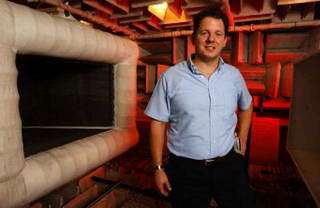
Image: Lou Cattafesta stands in the test section of the University of Florida’s newly completed anechoic, or anti-echo, wind tunnel.
The tunnel is one of only a handful in the country and currently the largest at a university designed specifically to reduce noise from planes passing overhead and landing. Engineers will use the $400,000 tunnel to learn how to reduce the noise caused by the flow of air over wings, flaps and landing gear – the primary sources of the annoying sound that reaches people on the ground when planes are landing.
“During approach for landing, the dominant noise comes from the airframe as opposed to the jet engines,” said Lou Cattafesta, a UF associate professor of mechanical and aerospace engineering. “We need to understand where the noise is coming from, how it is generated and how we can reduce it. That’s what this facility is geared toward doing.”
The wind tunnel, completed this spring after two years, is timely. Air travel is increasing worldwide, spurring the construction and expansion of airports and increasing noise-related problems, Cattafesta said. Also, engineers have reduced jet engine noise to an extent that it now makes sense to focus attention on the noise from other aircraft components.
“With airframe noise, as little as 10 years ago, very few people cared,” Cattafesta said. “But today’s engines have gotten so quiet during landing, airframe noise is what you hear.”
The tunnel, called “anechoic” because it is designed to minimize echoes, is one of only two at U.S. universities aimed at addressing this problem. It is larger and faster than its counterpart at the University of Notre Dame. Virginia Tech currently is refurbishing its large aerodynamic stability wind tunnel to make it suitable for airframe noise studies.
UF’s tunnel is housed in a soundproof room in one of UF’s mechanical and aerospace engineering buildings. The room’s walls and ceiling and even the door are covered with 3-foot-long fiberglass wedges designed to absorb 99 percent of the sound the engineers are concerned with. Anyone inside the tunnel must speak loudly to be heard by someone just a few feet away.
The tunnel itself is composed of a reinforced fiberglass inlet separated by an open 6-foot-long test section from an acoustically lined outlet that collects and diffuses the wind.
The chamber is not large enough to accommodate full-scale aircraft parts, so engineers plan to use scale models. They will place the models, expected to be one-tenth to one-fifth the size of the real thing, in the chamber, then measure the flow and noise they create – a noise intended to be untarnished either by unrelated noise from outside or echo effects inside.
“If I put something in the air flow, that’s what I want to hear, and that’s the only thing I want to hear,” Cattafesta said.
A 300-horsepower fan pulls air through the tunnel. It is located outside the building on its own concrete pad and foundation, which ensures its noise and vibration don’t contaminate experiments. The fan is capable of moving air at speeds of up to 170 mph, the typical speed of most commercial jets as they approach an airport for landing, Cattafesta said.
The soundproof room, built by Eckel Industries, was completed in 2002. But UF faculty including Mark Sheplak and Bruce Carroll and graduate and undergraduate students pitched in to design and build the tunnel. Otherwise, Cattafesta said, it would have been prohibitively expensive. NASA Langley provided the bulk of the funding for the project.
Mechanical and aerospace engineering doctoral students Jose Mathew and Chris Bahr said the toughest challenge was crafting 60 airfoils that turn the air flow 90 degrees as it leaves the building. The team needed to make that turn to fit the tunnel into the available space, and the fiberglass and rubber-filled vanes make the process as streamlined and quiet as possible, they said.
Cattafesta said engineers have long designed airplanes to be safe, reliable, fuel-efficient comfortable for their occupants. Traditionally, he said, “noise is generally not something you worry about until you hear it.”
But thanks to better composite materials and sophisticated computer design tools, that’s changing, he said, and the UF tunnel dovetails with that trend.
“It’s clear that by re-engineering things better and better we have an opportunity to reduce the noise,” he said. “We’re really putting ourselves in a position where we can experimentally look at these questions.”
Source: University of Florida


