Cassini Sees Into the Eye of a Monster Storm on Saturn
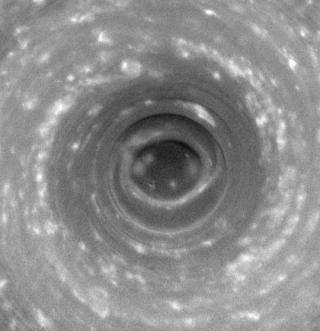
NASA's Cassini spacecraft has seen something never before seen on another planet -- a hurricane-like storm at Saturn's South Pole with a well-developed eye, ringed by towering clouds.
The "hurricane" spans a dark area inside a thick, brighter ring of clouds. It is approximately 5,000 miles across, or two thirds the diameter of Earth.
"It looks like a hurricane, but it doesn't behave like a hurricane," said Andrew Ingersoll, a member of Cassini's imaging team at the California Institute of Technology, Pasadena. "Whatever it is, we're going to focus on the eye of this storm and find out why it's there."
A movie taken by Cassini's camera over a three-hour period reveals winds around Saturn's South Pole blowing clockwise at 350 miles per hour. The camera also saw the shadow cast by a ring of towering clouds surrounding the pole, and two spiral arms of clouds extending from the central ring. These ring clouds, 20 to 45 miles above those in the center of the storm, are two to five times taller than the clouds of thunderstorms and hurricanes on Earth.
Eye-wall clouds are a distinguishing feature of hurricanes on Earth. They form where moist air flows inward across the ocean's surface, rising vertically and releasing a heavy rain around an interior circle of descending air that is the eye of the storm itself. Though it is uncertain whether such moist convection is driving Saturn's storm, the dark "eye" at the pole, the eye-wall clouds and the spiral arms together indicate a hurricane-like system.
Distinctive eye-wall clouds have not been seen on any planet other than Earth. Even Jupiter's Great Red Spot, much larger than Saturn's polar storm, has no eye or eye-wall, and is relatively calm at the center.
This giant Saturnian storm is apparently different than hurricanes on Earth because it is locked to the pole and does not drift around like terrestrial hurricanes. Also, since Saturn is a gaseous planet, the storm forms without an ocean at its base.
In the Cassini imagery the eye looks dark at light wavelengths where methane gas absorbs the light and only the highest clouds are visible.
"The clear skies over the eye appear to extend down to a level about twice as deep as the usual cloud level observed on Saturn," said Kevin H. Baines, of Cassini's visual and infrared mapping spectrometer team at NASA's Jet Propulsion Laboratory, Pasadena, Calif. "This gives us the deepest view yet into Saturn over a wide range of wavelengths, and reveals a mysterious set of dark clouds at the bottom of the eye."
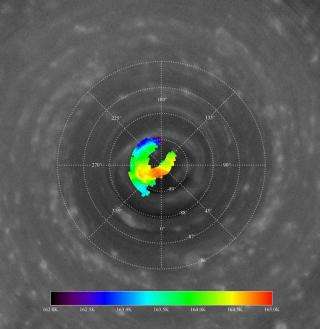
Infrared images taken by the Keck I telescope in Mauna Kea, Hawaii, had previously shown Saturn's South Pole to be warm. Cassini's composite infrared spectrometer has confirmed this with higher resolution temperature maps of the area. The spectrometer observed a temperature increase of about 4 degrees Fahrenheit at the pole. The instrument measured high temperatures in the upper troposphere and stratosphere, regions higher in the atmosphere than the clouds seen by the Cassini imaging instruments.
"The winds decrease with height, and the atmosphere is sinking, compressing and heating over the South Pole," said Richard Achterberg, a member of Cassini's composite infrared spectrometer team at NASA's Goddard Spaceflight Center, Greenbelt, Md.
Observations taken over the next few years, as the South Pole season changes from summer to fall, will help scientists understand the role seasons play in driving the dramatic meteorology at the south pole of Saturn.
Source: NASA


