Beetle feet stick to their promises
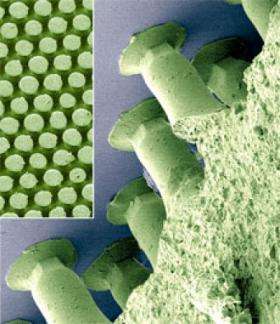
Mushroom-shaped microhairs are the secret of a new adhesive material which scientists at the Max Planck Institute for Metals Research in Stuttgart, Germany, have developed. Inspired by the soles of beetles' feet, and therefore biomimetic, the special surface structure of the material allows it to stick to smooth walls without any adhesives. Potential applications range from reusable adhesive tape to shoe soles for climbing robots and are therefore of considerable relevance to technology.
It has been known for some time how insects, spiders and geckos have such a remarkable talent for walking on walls and ceilings. Extremely thin hairs literally stick their feet to the wall and the larger the animal, the finer the hairs. Geckos, which are heavy compared to a fly, have been using nanotechnology for this purpose for millions of years. According to findings made by scientists at the Max Planck Institute for Metals Research in Stuttgart, the shape of the fibres is also significant; for example, spatula-shaped ends on the hairs provide particularly strong adhesion.
These discoveries aroused great expectations. Is it possible to simply copy the structure of the soles of insects' feet and before long find equivalent biomimetic, i.e. nature-inspired, adhesive materials in everyday use? The researchers at the Max Planck Institute for Metals Research and their colleauges at Gottlieb Binder GmbH in Holzgerlingen, a specialist company for fastener systems, needed plenty of staying power themselves, because the first generations of the surfaces they created with a variety of methods were not effective adhesives.
However, the scientists have now taken a big step forwards in copying the biological adhesive mechanism. They have developed a material with a biomimetic microstructure that exhibits excellent adhesive qualities, basing it on investigations of the foot soles of several types of beetle. Their particularly strong adhesive force is the result of very small, specially shaped hairs reminiscent of tiny mushrooms.
In rigorous tests carried out by the Max Planck researchers with measuring instruments developed especially for the purpose, the artificial adhesive system gave an impressive performance and demonstrated many benefits. It lasts for hundreds of applications, does not leave any visible marks and can be thoroughly cleaned with soap and water. The researchers found that five square centimeters of the material can hold objects weighing up to one hundred grams on walls. However, this limit is much lower for ceilings. Smooth structures, such as glass or polished wood, are good bases but woodchip wallpaper is not very suitable. "Insects also find it difficult to travel over slightly roughened surfaces - it's a fundamental problem for adhesion mechanisms," explained Project Leader Stanislav Gorb.
To manufacture the material, a mold, similar to a cake tin in baking, is used in which the required surface is embossed as a negative image. The mould is filled with a polymerizing mixture which is allowed to cure and then released from the mould. This sounds easy, but is the result of a "great deal of trial and error." The researchers found the construction of the microstructural "cake tin" particularly challenging and exactly how it works remains a trade secret. Optimizing the polymer mixture also taxed the researchers: if it is too fluid it runs out of the mold; if it is too viscose, it won't even go in.
Potential applications range from protective foil for delicate glasses to reusable adhesive fixtures - say goodbye to fridge magnets, here come the microhairs, which will also stick to your mirror, your cupboard and your windows. For example, the new material will soon be found in industrial production processes in the manufacture of glass components. It has already been shown to perform in higher weight categories: the artificial adhesive fibers on the soles of a 120 gram robot helped it to climb a vertical glass wall (Daltorio et al. 2005).
In their current research, the scientists are trying to improve the adhesion by refining the structures even further. "However, there's still a lot of work to be done by the Working Group. Something that functions smoothly in the laboratory is a long way away from large-scale production," explained Stanislav Gorb.
Citation: S. Gorb, M. Varenberg, A. Peressadko and J. Tuma, Biomimetic mushroom-shaped fibrillar adhesive microstructure, Journal of the Royal Society Interface 17 October 2006
Source: Max Planck Institute for Metals Research


