'Killer' B cells provide new link in the evolution of immunity
Oct 03, 2006
'Killer' B cells provide new link in the evolution of immunity
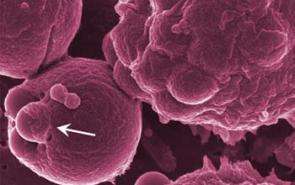
In the adaptive immune system in mammals, B cells produce antibodies to fight infection. In the more-primitive innate immunity in fish, scientists found that B cells take part in a process known as phagocytosis, by which immune system cells ingest foreign particles and microbes. The round cell in the lower left is B-cell ike from a trout. It is in the process of engulfing three latex beads, each (arrow) about 1 micron in diameter. Credit: J. Oriol Sunyer, School of Veterinary Medicine, University of Pennsylvania; image taken with the assistance of R. Meade, Biomedical Imaging Core Laboratory of the School of Medicine, University of Pennsylvania.

Researchers from the University of Pennsylvania School of Veterinary Medicine have discovered a unique evolutionary link between the most primitive innate form of immune defense, which has survived in fish, to the more advanced, adaptive immune response present in humans and other mammals.

The finding, which appears in the online version of the October issue of Nature Immunology, represents an evolutionary step for the mammalian immune system and offers a potential new strategy for developing much-needed fish vaccines.

In the adaptive immune system in mammals, B cells produce antibodies to fight infection. In the more-primitive innate immunity in fish, the scientists found that B cells take part in a process known as phagocytosis, by which immune system cells ingest foreign particles and microbes.

In modern mammals, the B cell is a highly adapted part of the immune system chiefly responsible for, among other things, the creation of antibodies that tag foreign particles and microbes for destruction.

"When examining fish B cells we see them actively attacking and eating foreign bodies, which is a behavior that, according to the current dogma, just shouldn't happen in B cells," said J. Oriol Sunyer, a professor in Penn Vet's Department of Pathobiology and leader of the research team.

The researchers determined that these attack B cells account for more than 30-40 percent of all immune cells in fish, whereas phagocytic cells make up only a small portion of the total number of immune cells in mammals.

According to Sunyer, the findings are important for not only understanding the evolution and function of immune cells in fish but also may point to novel roles of B cells in mammals. Their findings also have an agricultural implication. Vaccines currently given to farmed salmon, for example, appeal to the fish's adaptive immune response, which this research now shows to be a small part of the overall fish immune system.

Source: National Science Foundation

Explore further: Baby's life saved with groundbreaking 3-D printed device that restored his breathing

add to favorites email to friend print save as pdf

Related Stories

ISA virus spreads via red blood cells in blood vessels

Apr 10, 2013

New research shows how the interaction between Atlantic salmon and the ISA virus leads to the development and spreading of the influenza-like disease ISA in fish. The new findings may be of interest to research ...

Exposing the secrets of costly viruses

Feb 21, 2013

Researchers are making headway in discovering how two harmful viruses – ISAV and IPNV – sidestep the salmon immune system. Effective viral vaccines are now in sight.

Discovering cell surface proteins' behaviour

Feb 06, 2013

(Phys.org)—A Simon Fraser University chemist is the lead author on a new paper that advances scientific understanding of the structure and function of glycoproteins, in particular the number and positioning of sugars on ...

Recommended for you

Scientists discover molecule triggers sensation of itch

6 hours ago

Scientists at the National Institutes of Health report they have discovered in mouse studies that a small molecule released in the spinal cord triggers a process that is later experienced in the brain as ...

Discarded immune cells induce the relocation of stem cells

8 hours ago

Spanish researchers have discovered that the daily clearance of neutrophils from the body stimulates the release of hematopoietic stem cells from the bone marrow into the bloodstream, according to a report published today ...

User comments : 0

More news stories

Controlling mood through the motions of mitochondria

(Medical Xpress)—Regulating the distribution of power in neurons is done by a system that makes the national electric grid look simple by comparison. Each neuron has several thousand mitochondria confined ...

WHO: Scientific red tape mars efforts vs. virus

International efforts to combat a new pneumonia-like virus that has now killed 22 people are being slowed by unclear rules and competition for the potentially profitable rights to disease samples, the head ...

Google Drive sports new view and scan enhancements

(Phys.org) —Google Drive has a new look and functions. The makeover in Google Drive features scanning and interface enhancements that put the user into "card" mode. The enhancements make it easy for the ...