Watching how planets form
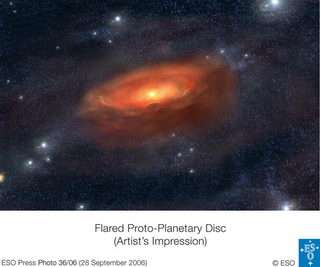
With the VISIR instrument on ESO's Very Large Telescope, astronomers have mapped the disc around a star more massive than the Sun. The very extended and flared disc most likely contains enough gas and dust to spawn planets. It appears as a precursor of debris discs such as the one around Vega-like stars and thus provides the rare opportunity to witness the conditions prevailing prior to or during planet formation.
"Planets form in massive, gaseous and dusty proto-planetary discs that surround nascent stars. This process must be rather ubiquitous as more than 200 planets have now been found around stars other than the Sun," said Pierre-Olivier Lagage, from CEA Saclay (France) and leader of the team that carried out the observations. "However, very little is known about these discs, especially those around stars more massive than the Sun. Such stars are much more luminous and could have a large influence on their disc, possibly quickly destroying the inner part."
The astronomers used the VISIR instrument on ESO's Very Large Telescope to map in the infrared the disc surrounding the young star HD 97048. With an age of a few million years, HD 97048 belongs to the Chameleon I dark cloud, a stellar nursery 600 light-years away. The star is 40 times more luminous than our Sun and is 2.5 times as massive.
The astronomers could only have achieved such a detailed view due to the high angular resolution offered by an 8-metre size telescope in the infrared, reaching a resolution of 0.33 arcsecond. They discovered a very large disc, at least 12 times more extended than the orbit of the farthest planet in the Solar System, Neptune. The observations suggest the disc to be flared. "This is the first time such a structure, predicted by some theoretical models, is imaged around a massive star," said Lagage.
Such a geometry can only be explained if the disc contains a large amount of gas, in this case, at least as much as 10 times the mass of Jupiter. It should also contain more than 50 Earth masses in dust.
The dust mass derived here is more than thousand times larger than what is observed in debris discs and Kuiper belt-like structures found around older, 'Vega-like' stars, such as Beta Pictoris, Vega, Fomalhaut and HR 4796. The dust around these stars is thought to be produced by collisions of larger bodies. The dust mass observed around HD 97048 is similar to the mass invoked for the (undetected) parent bodies in the more evolved systems. HD 97048's disc is thus most likely a precursor of debris discs observed around older stars.
"From the structure of the disc, we infer that planetary embryos may be present in the inner part of the disc," said Lagage. "We are planning follow-up observations at higher angular resolution with ESO's VLT interferometer in order to probe these regions.‚"
The scientists report their discovery in the 28 September issue of Science Express, the rapid online publication service of the journal Science: "Anatomy of a flaring proto-planetary disc around a young intermediate-mass star", by P.-O. Lagage et al.
Source: European Southern Observatory (ESO)


