Ferns provide model for tiny motors powered by evaporation
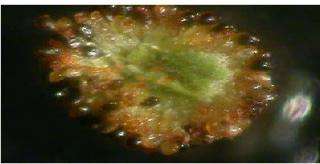
Scientists looked to ferns to create a novel energy scavenging device that uses the power of evaporation to move itself -- materials that could provide a method for powering micro and nano devices with just water or heat.
"We've shown that this idea works," said Michel Maharbiz, assistant professor of electrical engineering and computer science and principal investigator in the group that built the device. "If you build these things they will move. The key is to show that you can generate electricity from this."
As often happens, the research started while doctoral student Ruba Borno was exploring another idea entirely. Borno was interested in mimicking biological devices, specifically microchannels that plants use to transport water, so Maharbiz gave her a book on plants.
But something else in the book caught her attention – the section on how ferns spread their spores.
"It's essentially a microactuator," said Maharbiz, meaning that the fern sporangium transforms one form of energy, in this case heat via the evaporation of water, into motion. When the cells in the outer wall of the sporangium were water logged, the sporangium remained closed like a fist, storing the spores safely inside. But when the water in the outer wall evaporated, it caused the sporangium to unfurl and eject the spores into the environment.
The researchers examined some fern leaves under a microscope. They found that when exposed to light or heat or any evaporation-inducing event, the sporangia opened and released the spores.
"Once we saw that, we thought, ‘Oh, we have to build that,'" Maharbiz said.
The method for making the material is simple enough. A wafer is coated with silicone and the hit with light, causing a pattern. The residual pattern is lifted off and that is used for the device. It resembles a curved spine with equally spaced ribs fanning outward from the spine.
To make the device move, Borno said, they load the space between the ribs with water, and when the water evaporates, the surface tension of the water pulls on the tips of the ribs so that the tips move toward each other, straightening out the spine of the device. In this way, the closed device opens wide—it moves.
They plan to add electrical components to the device in an attempt to generate electricity. They predict that the device will be able to generate the same amount of electricity as other scavenging devices, say, a solar cell in a calculator.
The ideal application, Borno said, would be to power a remote sensor where it's impossible to change the batteries regularly.
Click here to see video.
Source: University of Michigan


