Astronomers discover strange new planet
Sep 14, 2006
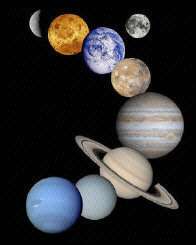
NASA montage of planets

U.S. astronomers have discovered a planet unlike any other known in the universe. Smithsonian scientists say the new planet was discovered using a network of small automated telescopes known as HATl. The planet -- designated HAT-P-1 -- orbits one member of a pair of distant stars 450 light-years away in the constellation Lacerta.

"We could be looking at an entirely new class of planets," said Gaspar Bakos, a Hubble fellow at the Harvard-Smithsonian Center for Astrophysics in Cambridge, Mass.

With a radius about 1.38 times that of Jupiter, HAT-P-1 is the largest known planet. But, in spite of its huge size, its mass is only half that of Jupiter.

"This planet is about one-quarter the density of water," Bakos said. "In other words, it's lighter than a giant ball of cork! Just like Saturn, it would float in a bathtub if you could find a tub big enough to hold it."

Astronomer Robert Boyes, co-discoverer of the planet, said, "This new discovery suggests something could be missing in our theories of how planets form."

Bakos is lead author of a paper submitted to the Astrophysical Journal describing the discovery.

Copyright 2006 by United Press International

Explore further: Communications satellite launched into space

add to favorites email to friend print save as pdf

Related Stories

Transit Search Finds Super-Neptune

Jan 20, 2009

(PhysOrg.com) -- Astronomers at the Harvard-Smithsonian Center for Astrophysics have discovered a planet somewhat larger and more massive than Neptune orbiting a star 120 light-years from Earth. While Neptune ...

Recommended for you

Dark, massive asteroid to fly by Earth on May 31

May 24, 2013

It's 1.7 miles long. Its surface is covered in a sticky black substance similar to the gunk at the bottom of a barbecue. If it impacted Earth it would probably result in global extinction. Good thing it is ...

Research team explains 'Lazarus' comets

May 24, 2013

Astronomers from the University of Antioquia have discovered a graveyard of comets. These once-dormant comets, dubbed by astronomers as "The Lazarus comets," are now rejuvenated.

NASA ships sensors for seafaring satellite to France

May 24, 2013

(Phys.org) —Three NASA-built instruments that are integral components of the next in a series of U.S./European ocean altimetry satellites have arrived in France for integration with their spacecraft in ...

Trip into space with DiCaprio costs $1.55m

May 24, 2013

Leonardo DiCaprio is going to get closer to stars of a different kind as he heads into space aboard the Virgin Galactic, and a well-heeled bidder at the Cannes Film Festival has paid 1.2 million euros (1.5 million) to be ...

User comments : 0

More news stories

Galaxies fed by funnels of fuel

(Phys.org) —Computer simulations of galaxies growing over billions of years have revealed a likely scenario for how they feed: a cosmic version of swirly straws.