ISS Astronauts Wrap Up Second Spacewalk
Sep 13, 2006
ISS Astronauts Wrap Up Second Spacewalk
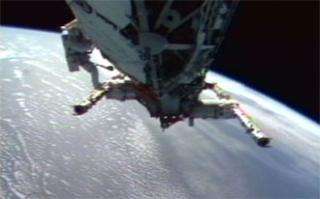
Mission Specialist Steve MacLean works on a task during the second spacewalk of the STS-115 mission. Photo Credit: NASA TV

The second STS-115 spacewalk is now in the history books. STS-115 Mission Specialists Dan Burbank and Steve MacLean concluded the spacewalk at 12:16 p.m. EDT after continued efforts to prepare the International Space Station’s P3/P4 truss for operation.

The 17.5-ton, 45-foot truss, which contains a set of solar arrays, was attached to the station Tuesday. The P3/P4 will provide power, data and communication services for the station. The arrays will be unfurled to a full length of 240 feet Thursday and will eventually double the station’s power capabilities.

Burbank and MacLean began their excursion at 5:05 a.m. and proceeded to move through the scheduled activities, which included the removal of launch locks and launch restraints on the Solar Alpha Rotary Joint (SARJ). Once activated, the rotary joint will allow the arrays to track the sun.

About 7:10 a.m. EDT, MacLean reported that one of the four bolts on the cover of the SARJ launch lock 8 was missing. The bolt had been there when he removed the cover to access the lock. MacLean reported he did not see the bolt in the SARJ mechanism. The cover is secure with three of the four bolts in place.

Later, the socket being used by MacLean to loosen a stubborn bolt on launch restraint 6B broke. MacLean retrieved a cheater bar from the tool box on the Z1 Truss. He broke the torque, but ultimately it took both he and Burbank to remove the bolt and launch restraint.

During the remainder of the spacewalk, the astronauts were instructed to perform get-ahead tasks. They prepared the P3 truss for use by the Mobile Transporter – a platform that allows the station’s robotic arm, Canadarm2, to move along the Integrated Truss Structure.

Mission Specialist Joe Tanner served as spacewalk coordinator. Mission Specialist Heidemarie Stefanyshyn-Piper assisted Tanner and operated Canadarm2. Tanner and Piper conducted the first spacewalk and will perform the third Friday.

Source: NASA

Explore further: Collisions of coronal mass ejections can be super-elastic

add to favorites email to friend print save as pdf

Related Stories

Spacewalkers Preparing New Truss for Operation

Sep 12, 2006

With the P3/P4 truss securely attached to the International Space Station, STS-115 Mission Specialists Joe Tanner and Heidemarie Stefanyshyn-Piper are now conducting a spacewalk to prepare the bus-sized structure ...

Shuttle countdown to begin Thursday

Aug 21, 2006

NASA is set to begin the countdown for the Florida launch of the space shuttle Atlantis' mission to the International Space Station at 6 p.m. EDT Thursday.

Recommended for you

Forecast for Titan: Wild weather could be ahead

19 hours ago

(Phys.org) —Saturn's moon Titan might be in for some wild weather as it heads into its spring and summer, if two new models are correct. Scientists think that as the seasons change in Titan's northern hemisphere, ...

SDO observes mid-level solar flare

19 hours ago

UPDATE 16:30 p.m. EDT: The M7-class flare was also associated with a coronal mass ejection or CME, another solar phenomenon that can send billions of tons of particles into space. While this CME was not Ea ...

NASA's IRIS mission readies for a new challenge

May 22, 2013

(Phys.org) —The time draws near. NASA is getting ready to launch a new mission, a mission to observe a largely unexplored region of the solar atmosphere that powers its dynamic million-degree outer atmosphere and drives ...

User comments : 0

More news stories

A hidden population of exotic neutron stars

(Phys.org) —Magnetars – the dense remains of dead stars that erupt sporadically with bursts of high-energy radiation - are some of the most extreme objects known in the Universe. A major campaign using ...

Russia evacuates drifting Arctic research station

Russia has ordered the urgent evacuation of the 16-strong crew of a drifting Arctic research station after ice floe that hosts the floating laboratory began to disintegrate, officials said Thursday.

Century-old science helps confirm global warming

(Phys.org) —Ocean measurements taken more than 135 years ago during the scientific expedition of HMS Challenger have provided further confirmation of human-produced global warming over the past century.

The secret lives, and deaths, of neurons

As the human body fine-tunes its neurological wiring, nerve cells often must fix a faulty connection by amputating an axon—the "business end" of the neuron that sends electrical impulses to tissues or other ...

White tiger mystery solved

White tigers today are only seen in zoos, but they belong in nature, say researchers reporting new evidence about what makes those tigers white. Their spectacular white coats are produced by a single change ...