First Giant Magellan Telescope Mirror Casting is 'Perfect'
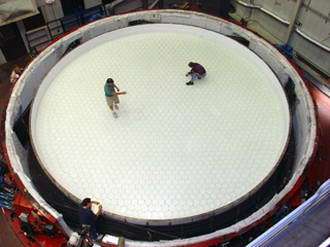
The University of Arizona Steward Observatory Mirror Lab's casting of the first mirror for the Giant Magellan Telescope (GMT) "appears to be essentially perfect," UA Steward Observatory director Peter Strittmatter said after astronomers got their first look at the glass last Friday.
Image: Mirror Lab casting team supervisor Randy Lutz (standing) and Damon Jackson check the first GMT mirror's surface after the furnace lid was removed Oct. 21, 2005. (Photo: Lori Stiles, University Communications)
"We're very happy to see this one come out looking so gorgeous," Mirror Lab Technical Director J. Roger Angel said. "We'll see more once the mold is removed, but so far, looking through the front surface, it looks great."
The mirror is the first of seven 8.4-meter (27-foot) mirrors that the Mirror Lab is making for the Giant Magellan Telescope. The GMT is the world's first extremely large ground-based telescope to start construction.
The colossal telescope will feature six giant off-axis mirrors around a seventh on-axis mirror. This arrangement will give it a 22-meter (72-foot) aperture, or 4.5 times the collecting area of any current optical telescope. It will have the resolving power of a 24.5-meter (80-foot) diameter telescope, or 10 times the resolution of the Hubble Space Telescope. The GMT is slated for completion in 2016 at a site in northern Chile.
Randy Lutz and the Mirror Lab casting team knew they had a superb first GMT mirror blank when they removed the casting furnace lid Oct. 21. But they aren't standing around to admire their handiwork. They’re racing to remove furnace walls and ready the mirror blank for moving off the furnace hearth.
"We're very eager to get on to the critical part of why we made this mirror -- to the polishing and the testing, which are really the new ground-breaking steps in making this mirror because its shape is so different," Angel said. "We're moving fast because we want to get on with casting the next mirror, a 3.7-meter mirror that will be needed to measure the shape of the GMT primary mirrors."
Mirror Lab workers are about to disassemble their facility's 7.5-story test tower (that's 27 meters, or 88 feet) and construct a higher tower that will hold the 3.7-meter (12-foot) mirror for measuring the off-axis GMT mirrors. The test mirror is crucial for making measurements needed for shaping all the primary mirrors so they gather and focus light as a single gargantuan primary mirror.
Meanwhile, Steward Observatory Mirror Lab scientists Buddy Martin and Jim Burge are already polishing a one-fifth scale prototype of the GMT primary. Polishing the full size off-axis mirror will be a huge step forward in the GMT project, Angel said.
For the casting last July, Mirror Lab workers used 40,000 pounds of Ohara E-6 borosilicate glass. The furnace hit peak temperature, 2,150 degrees Fahrenheit (1,178 Celsius) on July 23. As the furnace rotated at 5 revolutions per minute, glass melted around the 1,681 hexagonal cores in the mold. This created a 'honeycomb' mirror blank with a faceplate of the desired curvature. The honeycomb mirror weighs only a fifth as much as would a solid mirror of the same size.
The first GMT primary is the third 8.4-meter mirror cast at the Steward Observatory Mirror Lab. The GMT builds on the very successful 6.5-meter (21-foot) Magellan telescopes which many of the same GMT partners operate in Chile.
Eight institutions are partners in the GMT. They are the Carnegie Observatories, Harvard University, Smithsonian Astrophysical Observatory, University of Arizona, University of Michigan, Massachusetts Institute of Technology, University of Texas at Austin, and Texas A & M University.
The two other 8.4-meter mirrors cast at the Mirror Lab are at the Large Binocular Telescope (LBT) on Mount Graham, Ariz. U.S., Italian and German partners in the LBT released 'first light' images obtained with the first of the LBT's primary mirrors yesterday (Oct. 26). The LBT, the forerunner of the GMT, will be the world's most powerful single telescope when its two primary mirrors, mounted side-by-side, become operational in 2006.
Source: University of Arizona


