September 1, 2006 feature
Sterile neutrinos and the search for warm dark matter
Matteo Viel, a research fellow at the Institute of Astronomy in Cambridge, England, believes that particle physics and cosmology could be more compatible as scientists work toward understanding the origins and the nature of our universe.
And, with an international team that includes scientists from France and Italy, as well as a theorist from CERN in Switzerland, Viel has produced a paper that may just do that. It is titled “Can Sterile Neutrinos Be Ruled Out as Warm Dark Matter Candidates?”, and it addresses the possibility of a less-standard view of the universe. It was published in Physical Review Letters on August 17.
“We know that dark matter is one of the main constituents of our universe,” Viel tells PhysOrg.com. “The most popular view is that this dark matter is mostly cold. And while some things can be explained by cold dark matter, there are some things, especially on a smaller scale, that are better explained by a dominance of warm dark matter.” Things, the Letter explains, like pulsar velocity kick, universe re-ionization at a high redshift. Warm dark matter, in the form of sterile neutrinos, could even possibly help with grand unification theories in particle physics.
Viel and his colleagues studied a subset of data taken from the Sloan Digital Sky Survey (SDSS) to find differences in warm and cold dark matter. The subset included quasars that show the absorptions of the photons emitted by a distant source by the intervening neutral hydrogen which populate intergalactic structures. Using the SDSS data, Viel and his peers used computers to model different scenarios using warm and cold dark matter to get an idea of what objects in a forming universe might look like.
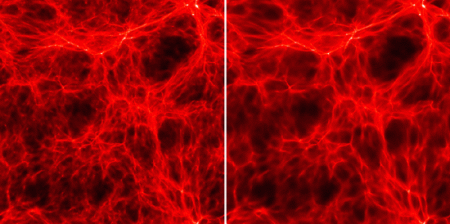
Two figures show how intergalactic structures at high redshift look in cold dark matter (left) and warm dark matter (right) models. The size of the simulated region corresponds to 3.3 million light-years. In warm dark matter models, the structures are more diffused.
“Among all warm dark matter particles,” says Viel, “there are neutrinos. Neutrinos come in two kinds: active and sterile. We quantify the impact of the sterile neutrinos on intergalactic structures when the universe was about 10% of its present age.”
The problem, though, arrives in the fact that a group in Ohio, using observational data, discovered an upper limit to neutrino mass that is smaller than Viel and his group’s lower limit. This means that the findings are incompatible. So, does this result rule out sterile neutrinos as warm dark matter candidates? “Yes,” says Viel, “and no.”
In a standard neutrino production scenario, there is leptonic symmetry. In such a universe, sterile neutrinos could not be dark matter candidates. But Viel and his team explored some new possibilities, including leptonic symmetry, and discovered that sterile neutrinos are still good candidates for warm dark matter. “What we need now,” he says, “are further parameters — tighter constraints — to study.”
This is where a combination of particle physics and cosmology could really help. “This is really a work that lies between particle physics and cosmology,” he explains. By collecting higher resolution data on intergalactic structures, better constraints could be developed for particle physics experiments in the laboratory. “If we can find better constraints, the physics community can tailor experiments in those ranges that cosmologists have found. It is important for these communities to interact, bring data and share models of the universe.”
“There are infinite numbers of consequences in the development of the universe, depending on warm or cold dark matter,” says Viel. “If we can get tighter constraints on even one property of sterile neutrinos, through some direct detection experiments or by observation, it would be an enormous improvement of our understanding of the universe.”
By Miranda Marquit, Copyright 2006 PhysOrg.com


