'Hourglass Figure' Points to Magnetic Field's Role in Star Formation
Aug 11, 2006
'Hourglass Figure' Points to Magnetic Field's Role in Star Formation
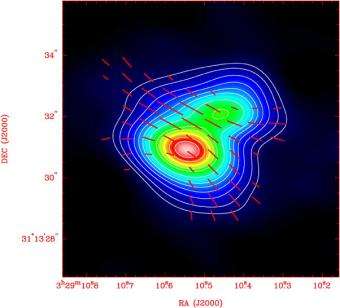
The protostellar system NGC 1333 IRAS 4A is the first textbook example of an hourglass-shaped magnetic field (shown by dashed red lines on this color-coded submillimeter image). The pear-shaped green and red region marks the locations of two still-forming stars. Gravity is pulling the gas and dust of this interstellar cloud clump inward, warping the magnetic field in the process. Taken with the Smithsonian's Submillimeter Array, this image is about 7 arcseconds on a side, which translates to a physical size of 2,700 astronomical units (using a distance to the system of 980 light-years). Image credit: J. Girart (CSIC-IEEC), R. Rao (ASIAA) and D. Marrone (CfA)

Long predicted by theory, the Smithsonian's Submillimeter Array has found the first conclusive evidence of an hourglass-shaped magnetic field in a star formation region. Measurements indicate that material in the interstellar cloud is dense enough to allow it to gravitationally collapse, warping the magnetic field in the process.

Astronomers Josep Girart (Institute of Space Studies of Catalonia, Spanish National Research Council), Ramprasad Rao (Institute of Astronomy and Astrophysics, Academia Sinica), and Dan Marrone (Harvard-Smithsonian Center for Astrophysics) studied the protostellar system designated NGC 1333 IRAS 4A. This system of two protostars is located approximately 980 light-years from Earth in the direction of the constellation Perseus.

They reported their findings in the August 11 issue of the journal Science.

"We selected this system because previous work had offered tantalizing hints of an hourglass-shaped magnetic field," explained Marrone. "The Submillimeter Array offered the resolution and sensitivity we needed to confirm it."

NGC 1333 IRAS 4A is part of the Perseus molecular cloud complex - a collection of gas and dust holding as much mass as 130,000 suns. This region is actively forming stars. Its proximity to Earth and young age make the Perseus complex an ideal laboratory for studying star formation.
'Hourglass Figure' Points to Magnetic Field's Role in Star Formation
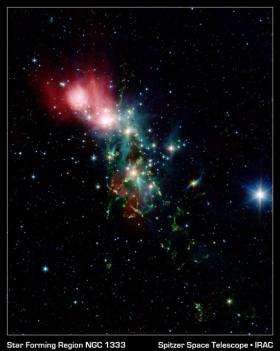
The star-forming region NGC 1333 contains dozens of new stars like the Sun but less than 1 million years old. Spitzer's IRAC camera reveals those stars, as well as warm dust glowing red and bright green shock fronts in this color-coded infrared image. Its proximity to Earth and young age make NGC 1333 an ideal laboratory for studying low-mass star formation. Image credit: NASA/JPL-Caltech/R. Gutermuth & A. Porras (CfA)

Theorists predict that collapsing molecular cloud cores - the seeds of star formation - have to overcome the support provided by their magnetic field in order to form stars. In the process, the competition between gravity pulling inward and magnetic pressure pushing outward was expected to produce a warped, hourglass pattern to the magnetic field within these collapsed cores.

Using the Array, Marrone and his colleagues observed dust emission from IRAS 4A. Because the magnetic field aligns the dust grains in the cloud core, the team could measure the magnetic field's geometry and estimate its strength by measuring the polarization of the dust emission.

"With the special polarization capabilities of the SMA we see the shape of the field directly. This is the first textbook example of theoretically predicted magnetic structure," said Rao.

The data indicate that, in the case of IRAS 4A, magnetic pressure is more influential than turbulence in slowing star formation within the cloud core. The same likely is true for similar cloud cores elsewhere.

Despite the moderating influence of the magnetic field, IRAS 4A is dense enough for gravitational collapse to continue. Approximately a million years in the future, two sunlike stars will shine where only a dust-cloaked cocoon lies today.

The SMA is a collaborative project of the Smithsonian Astrophysical Observatory (SAO) and the Academia Sinica Institute of Astronomy and Astrophysics (ASIAA) in Taiwan. It is located atop Mauna Kea in Hawaii.

Source: Harvard-Smithsonian Center for Astrophysics

Explore further: New X-ray method shows how frog embryos could help thwart disease

add to favorites email to friend print save as pdf

Related Stories

What left these spooky trails in the sky?

May 08, 2013

Ball lightning? Spectral orbs? Swamp gas? Early this morning, May 7, these eerie glowing trails were seen in the sky above the Marshall Islands and were captured on camera by NASA photographer John Grant. ...

'Tis the season—for plasma changes at Saturn

May 03, 2013

(Phys.org) —A University of Iowa undergraduate student has discovered that a process occurring in Saturn's magnetosphere is linked to the planet's seasons and changes with them, a finding that helps clarify ...

NASA celebrates four decades of plucky Pioneer 11

Apr 09, 2013

Forty years ago, on April 5, 1973, a small, ambitious spacecraft launched from Cape Canaveral, heading towards the third-brightest point of light in the night sky. Following in the footsteps of its sister ...

Recommended for you

Bringing life into focus

May 17, 2013

Spinning-disk confocal microscopy is an optical imaging technique that can be used to generate detailed three-dimensional fluorescence images of living cells and their contents. Although a powerful tool for ...

World's smallest droplet

May 17, 2013

(Phys.org) —Physicists may have created the smallest drops of liquid ever made in the lab. That possibility has been raised by the results of a recent experiment conducted by Vanderbilt physicist Julia Velkovska and her ...

User comments : 0

More news stories

New principle may help explain why nature is quantum

Like small children, scientists are always asking the question 'why?'. One question they've yet to answer is why nature picked quantum physics, in all its weird glory, as a sensible way to behave. Researchers ...

Manipulating Lorentz and Fano spectral line shapes

(Phys.org) —It is widely known that the optical properties of certain materials can be modified by using lasers to control the quantum states of their optical electrons. Lasers that can generate ultra-short ...

New colonoscope provides ground-breaking view of colon

A ground-breaking advance in colonoscopy technology signals the future of colorectal care, according to research presented today at Digestive Disease Week(DDW). Additional research focuses on optimizing the minimal withdrawal ...

Yahoo Japan suspects 22 million IDs stolen

Yahoo Japan Corp. has said it suspects up to 22 million user IDs may have been stolen during an unauthorised attempt to access the administrative system of its Yahoo! Japan portal.

US seizes Bitcoin operator accounts

US authorities seized the accounts of a Bitcoin digital currency exchange operator, claiming it was functioning as an "unlicensed money service business," court documents showed Friday.