Kids need more time than adults give them, study finds
Aug 09, 2006
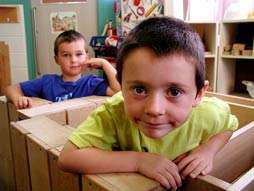
Children playing. Photo credit: Wayne MacPhail

Further proof that children require more time comes via a study to be published today in Developmental Science asserting that the fast pace expected by adults - both parents and educators - can be beyond children's perceptual abilities.

"Children are increasingly being expected to provide an adult-level of detail and information," says David Shore, associate professor in McMaster University's Department of Psychology, Neuroscience & Behaviour. "Adults have had years to hone their perceptual skills; children - even 10 year olds - are just starting out."

The study is the first to probe so-called change blindness in children, a hot topic in psychology circles especially when it pertains to gauging the veracity of children who are called upon to give eyewitness testimony in court.

The results surprised Shore.

"When it comes to many aspects of attention, an eight-year-old's skill is adult-like," says Shore. "But on this particular skill we never thought 10-year-olds would differ so dramatically from adults. Kids do not appear adult-like in this regard until their early teens."

Shore's study looked at the development of change detection in children ranging from ages six to 10 and found that, contrary to societal perception, even 10-year-olds cannot be relied upon to provide adult-like details. The reason is that children have undeveloped and, therefore, imprecise attention, he says. Their difficulties with eyewitness testimony may not stem from memory errors alone but may arise due to difficulty in perceiving some critical aspects of a scene in the first place.

"We expect children to be adult-like, because of their proficiency on computers or because they display adult-like speech," he says, "so we give them instructions and get impatient when they can't understand what we tell them the first time. Children learn through repetition, at a pace suitable to the child, not to the curriculum. Once upon a time, kids controlled their own pace; now that pace is controlled by adults."

Source: by Jane Christmas, McMaster University

Explore further: 50 percent of Australians who oppose vaccination get their information from the Internet

add to favorites email to friend print save as pdf

Related Stories

Recommended for you

Fast-acting mothers' milk for healthier babies

20 minutes ago

Human breastmilk responds quickly to protect the child when there is an infection in mothers or babies, according to new international research led by The University of Western Australia.

US teen birth rate drops to record low

1 hour ago

US teen births have dropped to a record low, but the country still has one of the highest rates among developed nations, the US Centers for Disease Control and Prevention said Thursday.

User comments : 0

More news stories

US teen birth rate drops to record low

US teen births have dropped to a record low, but the country still has one of the highest rates among developed nations, the US Centers for Disease Control and Prevention said Thursday.

Brain can be trained in compassion, study shows

Until now, little was scientifically known about the human potential to cultivate compassion—the emotional state of caring for people who are suffering in a way that motivates altruistic behavior.

Unlocking secrets of cell reproduction

Research published in Open Biology today identifies, for the first time, nearly all the genes required for reproduction of a cell in a living organism.

Very Large Telescope celebrates 15 years of success

(Phys.org) —With this new view of a spectacular stellar nursery ESO is celebrating 15 years of the Very Large Telescope—the world's most advanced optical instrument. This picture reveals thick clumps ...

US House sends message on Keystone pipeline

US lawmakers agreed to a bill that would speed construction of a Canada-US oil pipeline and circumvent the need for President Barack Obama's approval for the $5 billion project.

Be prepared for weather extremes

Unsettled weather is an Iowa mainstay, and so is Inside's annual reminder of the university's severe weather safety and preparedness guidelines—for storms, extreme heat, flooding and more.