October 20, 2005 feature
How to find a black hole
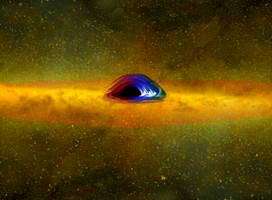
Black holes. Just the name evokes mystery and intrigue. But do they really exist?
Scientists have discovered at least 20 objects in 20 different galaxies that are potential black holes and may contain event horizons. A black hole may even be at the center of the Milky Way Galaxy.
Since the 1960’s, physicists have been analyzing the theory of black holes and astronomers have been looking for examples in the universe.
A black hole is a concentration of mass so enormous that it exhibits its own gravitational force. This force is so great, that nothing escapes from it.
Researchers have found a method to find black holes and analyze their characteristics, such as their mass and gravitational force, to determine if they are in fact black holes.
Astrophysicists first look for compact, massive, dark objects in the center of nearby galaxies. Then they use Newtonian physics and a series of equations to measure the mass and spin angle of the object.
If the object is at least three times the mass of the sun, it is classified as a black hole. However, the mass of most objects found are 10 million times the mass of the sun.
Current research focuses on finding yet more black holes and in particular, discovering if they contain event horizons.
An event horizon is a one-way barrier that causes the isolation of the black hole’s interior from the outside universe. Matter, energy, information, and radiation, for example, can fall into the black hole, but nothing, not even light, can get out.
For years, astronomers have been studying a huge, dark object in the center of the Milky Way Galaxy that affects the motion of the stars and gasses that are nearby.
Infrared technology has been used to discover that there are stars orbiting this object. The mass of this object is 30 million times the mass of the sun. Most astrophysicists have accepted that this is a black hole in the center of the Milky Way Galaxy.
Physicists and astronomers alike are working to find even more black holes in many different galaxies, and to find stronger evidence that they have event horizons.
So it appears that the existence of black holes may not be such a mystery. However, the intrigue still remains at the thought of enormous black objects with masses at least 10 million times that of the sun.
Could they be at the center of every galaxy?
Reference:
Narayan R. 2005. Black holes in astrophysics. New Journal of Physics. 7:199.
Image: Max Planck Institute for Extraterrestrial Physics
Story: by Gina Buss, Copyright PhysOrg.com


