New Report Says Human Tampering Threatens Planet's Life-Sustaining Surface
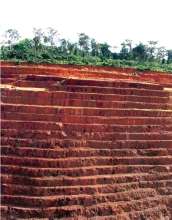
In a report released today, scientists call for a new systematic study of the Earth's "critical zone"--the life-sustaining outermost surface of the planet, from the vegetation canopy to groundwater and everything in between.Understanding and predicting responses to global and regional change is necessary, they say, to mitigate the impacts of humans on complex ecosystems and ultimately sustain food production.
"Development is having a great effect on the critical zone," said soil scientist Donald Sparks of the University of Delaware and co-chair of the NSF workshop that led to the report, entitled Frontiers in Exploration of the Critical Zone. "Converting some of the best land around the world into buildings, roads and concrete has implications for air and water quality and biodiversity, and over time could put pressure on our ability to produce food.
Critical zone sites include an extraordinary diversity of soils and ecosystems ranging from the tropics to the poles, from deserts to wetlands, and from rock-bound uplands to delta sediments.
"Because the critical zone includes air, water and soil and is the focal point of food production, it has a major effect on human life," Sparks said. "It is imperative that we better understand the interactions that occur there."
The report calls for an international Critical Zone Exploration Network, as well as a systematic approach across a broad array of sciences--including geology, soil science, biology, ecology, chemistry, geochemistry, geomorphology and hydrology--to study critical-zone processes.
"We need to understand how living organisms interact with the solid earth at the scale of a billionth-of-a-meter as well as the scale of landscapes, how these effects have changed over geologic time, and how they will change into the future as humans continue to drastically alter the earth's surface," said Sue Brantley, a Penn State University geoscientist who co-chaired the workshop.
Scientists need to determine "how the physical, chemical and biological components of Earth's weathering transforms mineral and organic matter, sculpts terrestrial landscapes, and controls the exchange of greenhouse gases and dust with the global atmosphere," said Enriqueta Barrera, program director in the National Science Foundation's Division of Earth Sciences, which funded the workshop that led to the report.
Scientists believe four key questions surround activity of the atmosphere, landforms, ecosystems and water.
• What processes control fluxes of carbon, particulate and reactive gases in the atmosphere?
• How do variations in, and changes to, chemical and physical weathering processes impact the critical zone?
• How do weathering processes nourish ecosystems?
• How do biogeochemical processes govern long-term sustainability of water and soil resources?
Funding for the critical zone workshop and associated activities was provided by grants from NSF's Division of Earth Sciences to the University of Delaware and Penn State, and by the NSF Experimental Program to Stimulate Competitive Research (EPSCoR) program in Delaware.
Source: NSF


