Novel nano-etched cavity makes leds 7 times brighter
Jul 20, 2006
Novel nano-etched cavity makes leds 7 times brighter
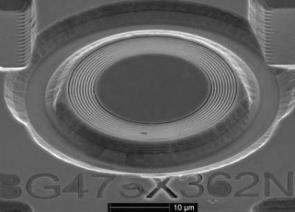
Etched nanostructured rings around an LED can make it more than seven times brighter. The novel technique developed at NIST may have applications in areas such as in biomedical imaging where LED brightness is crucial. Credit: NIST

Researchers at the National Institute of Standards and Technology have made semiconductor light-emitting diodes (LEDs) more than seven times brighter by etching nanoscale grooves in a surrounding cavity to guide scattered light in one direction. The novel nanostructure, which may have applications in areas such as in biomedical imaging where LED brightness is crucial, is described in the July 17 issue of Applied Physics Letters.

Semiconductor LEDs are used increasingly in displays and many other applications, in part because they can efficiently produce light across a broad spectrum, from near-infrared to the ultraviolet. However, they typically emit only about two percent of the light in the desired direction: perpendicular to the diode surface. Far more light skims uselessly below the surface of the LED, because of the extreme mismatch in refraction between air and the semiconductor. The NIST nanostructured cavity boosts useful LED emission to about 41 percent and may be cheaper and more effective for some applications than conventional post-processing LED shaping and packaging methods that attempt to redirect light.

The NIST team fabricated their own infrared LEDs consisting of gallium arsenide packed with "quantum dots" of assorted sizes made of indium gallium arsenide. Quantum dots are nanoscale semiconductor particles that efficiently emit light at a color determined by the exact size of the particle. The LEDs were backed with an alumina mirror to reflect the light emitted backwards. The periphery of each LED was turned into a cavity etched with circular grooves, in which the light reflects and interferes with itself in an optimal geometry.

The researchers experimented with different numbers and dimensions of grooves. The brightest output was attained with 10 grooves, each about 240 nanometers (nm) wide and 150 nm deep, and spaced 40 nm apart. The team spent several years developing the design principles and perfecting the manufacturing technique. The principles of the method are transferable to other LED materials and emission wavelengths, as well as other processing techniques, such as commercial photolithography, according to lead author Mark Su.

Citation: M.Y. Su and R.P. Mirin. Enhanced light extraction from circular Bragg grating coupled microcavities. Applied Physics Letters. July 17.

Source: NIST

Explore further: Kinks and curves at the nanoscale

add to favorites email to friend print save as pdf

Related Stories

Tomatoes with extra vitamin C via LED lamps

May 09, 2013

(Phys.org) —Tomatoes can contain more vitamin C if they are exposed to extra light from LED lamps while growing on the plant. This has been proven by research by Wageningen UR Greenhouse Horticulture in ...

Secret streets of Britain's Atlantis are revealed

May 10, 2013

A University of Southampton professor has carried out the most detailed analysis ever of the archaeological remains of the lost medieval town of Dunwich, dubbed 'Britain's Atlantis'.

Dust involved in sulfate production in clouds

May 10, 2013

(Phys.org) —A new study from Germany has studied the tiny dust particles within clouds and their influence on the climate. The influence of dust particles on cloud formation and on the chemical reactions ...

X-ray laser brings cellular messengers into focus

May 10, 2013

Last year's Nobel Prize in Chemistry – shared by Stanford School of Medicine Professor Brian Kobilka and Robert Lefkowitz of Duke University – recognized groundbreaking research in G protein-coupled receptors (GPCRs). GPCRs are embedded in cell membranes. They i ...

Recommended for you

Kinks and curves at the nanoscale

1 hour ago

One of the basic principles of nanotechnology is that when you make things extremely small—one nanometer is about five atoms wide, 100,000 times smaller than the diameter of a human hair—they are going ...

Snake's ultra-black spots may aid high-tech quest

May 16, 2013

Scientists have identified nanostructures in the ultra-black skin markings of an African viper which they said Thursday could inspire the quest to create the ultimate light-absorbing material.

User comments : 0

More news stories

Kinks and curves at the nanoscale

One of the basic principles of nanotechnology is that when you make things extremely small—one nanometer is about five atoms wide, 100,000 times smaller than the diameter of a human hair—they are going ...

Catching graphene butterflies

Writing in Nature, a large international team led Dr Roman Gorbachev from The University of Manchester shows that, when graphene placed on top of insulating boron nitride, or 'white graphene', the electr ...